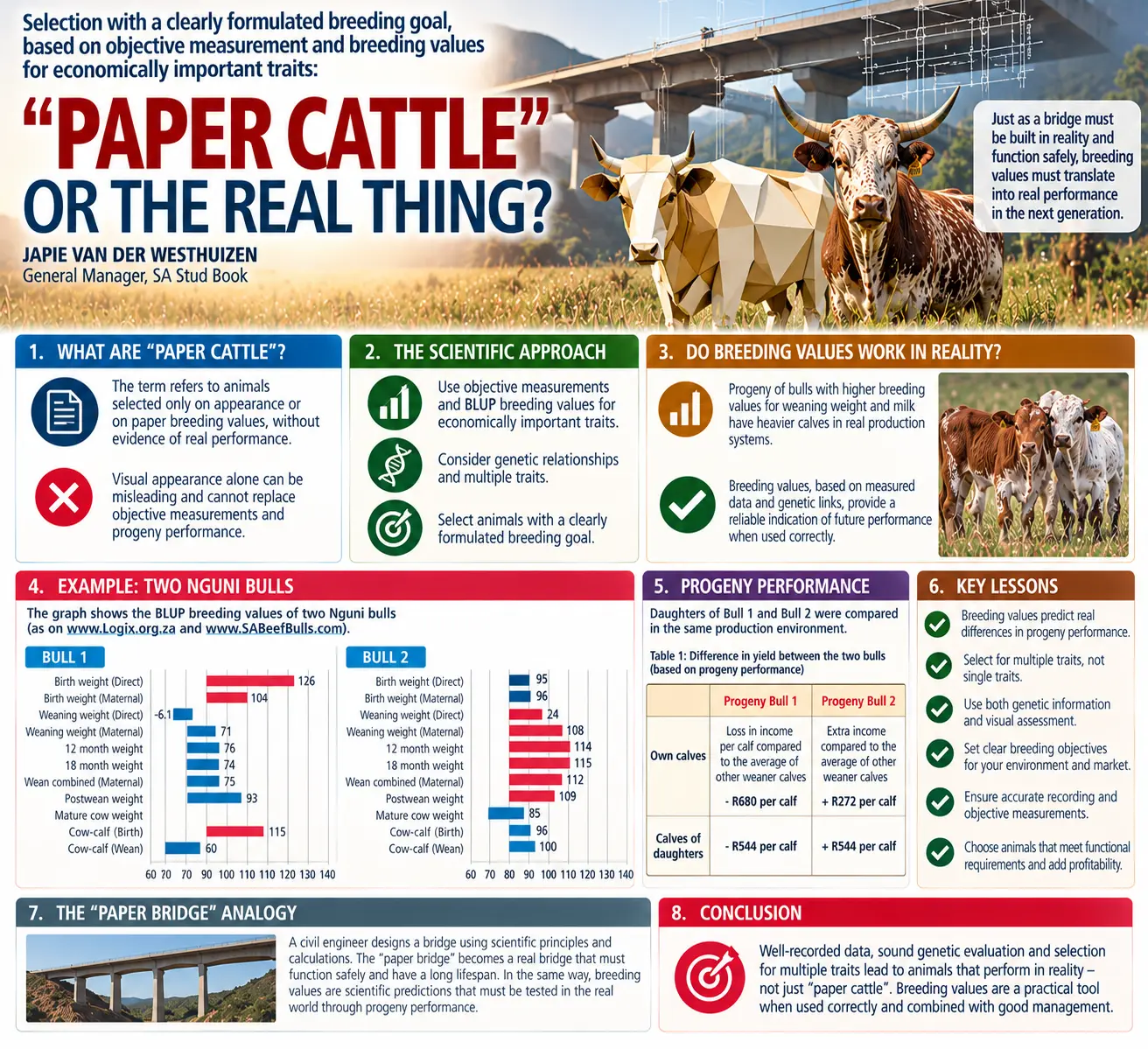
Understanding the difference between breeding values and measured and observed performance.
Download this publication
PDF · 170 KB · 96 downloads
From the document
Enquiries? info@studbook.co.za
Contradictions between EBVs and performance Dr J van der Westhuizen SA Stud Book Sometimes farmers observe discrepancies between breeding values and the performance observed on their farm as well as the difference between the progeny of the same bull on different farms. This is not always the case and in general breeding values are trustworthy and essential tools in the selection of animals. There are various sources of information to estimate breeding values and they must be understood to interpret and use EBVs more effectively. The heritability of a trait is used to estimate breeding values and is the proportion of a trait’s expression due to the animal’s genetic composition. Simply having specific genes does not necessarily mean it will be expressed. The remaining portion is mostly due to environmental factors and leads to greater overall variation of the trait. The genetic potential of an animal places a limit on the possible performance of an animal but does not mean this limit will be reached. The environment in which the animal is expected to perform can mask the true genetic effect. Sophisticated and highly mathematical techniques are therefore required to “remove” the mask and reveal the true genetic contribution in the form of an EBV. Furthermore, accurate breeding value estimation relies on connections with and performance of relatives. These relatives may not be on your farm and their performance will not be known to you, but will be on the Logix system and taken into account during the genetic evaluation. Missing measurements of relatives has a detrimental effect on the accuracy of breeding values. Using EBVs is immensely important in animal selection. Well adapted genetically superior animals will perform better and be more efficient. Even though the environment plays a large role, the genetic value of a trait will determine the true potential of the animal. Some feel that the breeding values are not able to accurately determine an animal’s genetic merit. This is a common enquiry: The progeny of a bull with average- or below-average breeding values perform well on your farm. How can this be? Why is this superior performance not reflected in the bull’s breeding values? Among others, the following factors are possible contributors to this perceived contradiction: 1.
The environmental mask: The animal cannot reach its genetic potential if the environment does not allow it. The proportion of variation of a trait due to …
The opening of the PDF. Download it above for the full document.