How can genomics improve livestock breeding beyond conventional performance recording and pedigree information? Dr Helena Theron explains how SNP markers support parentage verification, detection of specific genetic variants and defects, and more accurate genomic-enhanced breeding values (GEBVs). She explores the potential of genomic selection for difficult-to-measure traits such as fertility, adaptation and disease resistance, while explaining why further research and sound statistical methods remain essential. The article emphasises that genomics can broaden the information available to breeders, but balanced selection and good animal husbandry remain fundamental.
Download this publication
PDF · 671 KB · 1 download
From the document
DR HELENA THERON SA STUD BOOK | PRETORIA OFFICE
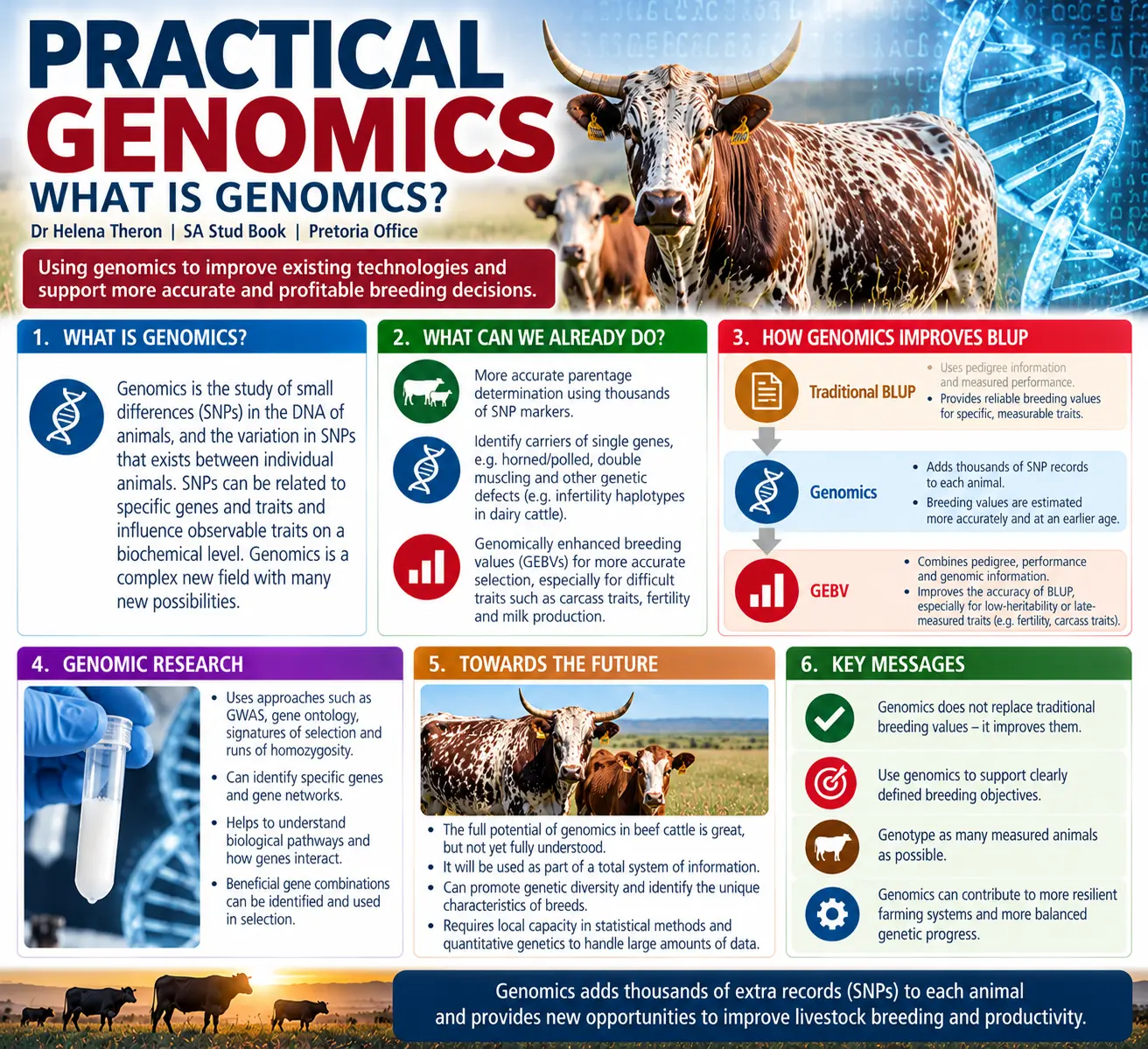
enomics is the study of small differences (called SNPs), in the DNA
of animals, and the variation in SNPs that exists between individual animals. It is therefore possible to determine which SNP combinations can relate to specific genes and traits. SNPs influence observable traits on a biochemical level, such as the production of proteins and enzymes. Genomics is therefore a complex new field with many new possibilities.
What can we already do with genomics? Genomics is currently used very successfully to improve existing technologies, such as very accurate parenting determination, simply because thousands of more markers are available to solve parentage than with previous DNA technology.
Current BLUP technology works on specific economic traits that can be measured, for example weaning weight, and the heritability and genetic correlations with other traits. However, other traits like for example adaptation and disease resistance, are also important, but relatively difficult to define and measure. Fertility, one of the most important traits for successful beef farming, is also a
Genomics is also used to detect the carriers of single genes, such as horned / polled, or genetic defects such as double muscling. Adverse genes have also been
good example of such a trait. Genomic selection will not only focus on the trait ‘fertility’, but on the complete gene network, which also considers all biological, metabolic,
discovered, such as the infertility haplotypes identified
and biochemical traits that affect fertility.
It is also used very effective for estimating more accurate
values are based on pedigree information and measurements, while genomic information is included for GEBVs (genomically enhanced breeding values) as an additional source of information. GEBVs are already available for some South African beef cattle breeds. This has the added benefit of improving BLUP technology because breeding values are
Man wants simple answers to complex questions. The true potential of genomics in beef cattle is great, but it is not yet fully understood. It will probably be used as part of a total system of information. The potential of genomics extends far beyond genetic improvement and can affect the resilience of the entire farming system. It can also be used, for example, to promote genetic diversity in breeds, bring about more balanced genetic progress, as well as identify the specific characteristics
estimated more accurately at an earlier
that make a breed unique.
The opening of the PDF. Download it above for the full document.