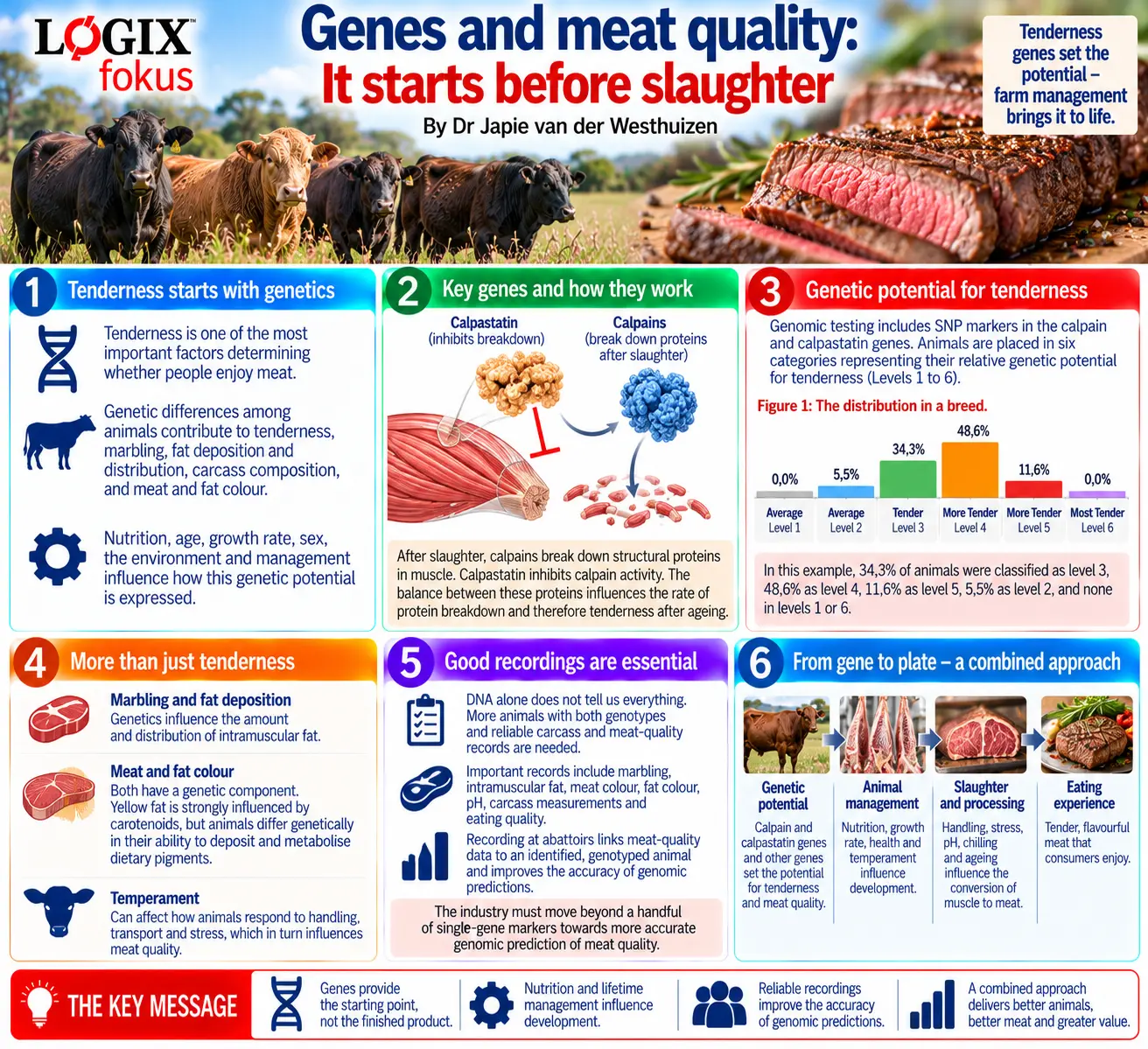
What determines whether beef is tender and enjoyable to eat? This article explains why meat quality starts with the animal?s genetics, long before slaughter. Genetic differences influence tenderness, marbling, fat deposition, carcass composition and meat colour, while nutrition, management, stress and post-slaughter handling affect the final outcome. It describes how SA Stud Book?s genomic service uses markers in the calpain and calpastatin genes to classify animals according to their genetic potential for tenderness. The article also highlights the need to link genomic profiles to reliable abattoir records, supporting more accurate selection and initiatives such as Authentic Stud Meat (ASM).
Download this publication
PDF · 1.7 MB · 1 download
From the document
Genes and meat quality: It starts before slaughter
By Dr Japie van der Westhuizen
enderness is one of the most important factors determining whether people enjoy the meat-eating experience. Yet tenderness is not created at the abattoir. It starts with the animal’s genetics, even before it is born. Meat quality is a complex trait. Genetic differences among animals contribute to tenderness, marbling, fat deposition and distribution, carcass composition, and meat and fat colour. Nutrition, age, growth rate, sex, the environment and management influence how that genetic potential is ultimately expressed. After slaughter, naturally occurring enzymes (calpains) break down structural proteins in muscle. Calpastatin inhibits calpain activity. The balance between these proteins influences the rate of post-mortem protein breakdown and therefore tenderness after ageing. SA Stud Book’s genomic service includes SNP markers in the calpain and calpastatin genes. Research in cattle populations has demonstrated associations between variants in these genes and measures of tenderness. Information from single-gene variants places animals into six categories representing their relative genetic potential for tenderness. Levels 1 and 2 represent lower genetic potential, levels 3 and 4 intermediate-to-higher potential, and levels 5 and 6 the highest potential. In Figure 1, 34,3% of the animals were classified as level 3, 48,6% as level 4 and 11,6% as level 5, while only 5,5% were in level 2 and none in levels 1 or 6. Genomic testing not only reveals variation but, more importantly, identifies animals with more desirable combinations. Marbling is also influenced by many genes and strongly affected by nutrition
Figure 1: The distribution in a breed.
and the animal’s stage of maturity. Meat colour likewise has a genetic component, although (post-mortem) pH, ageing, oxygen exposure and handling have a major influence. Even fat colour has a genetic story. For example, yellow fat is strongly influenced by carotenoids consumed in green forage, but cattle differ genetically in their ability to deposit and metabolise these pigments. Another, less obvious connection between genetics and meat quality is temperament. Temperament can affect how an animal responds to handling, transport, and other stressful events. Stress and physical exertion alter muscle energy metabolism and influence the biochemical conditions that develop after slaughter, and therefore meat quality.
Good recordings are always needed An important limitation to genomic prediction is that DNA, based on single genes alone, does not tell us everything. The industry must move beyond a handful of single-gene markers towards more …
The opening of the PDF. Download it above for the full document.