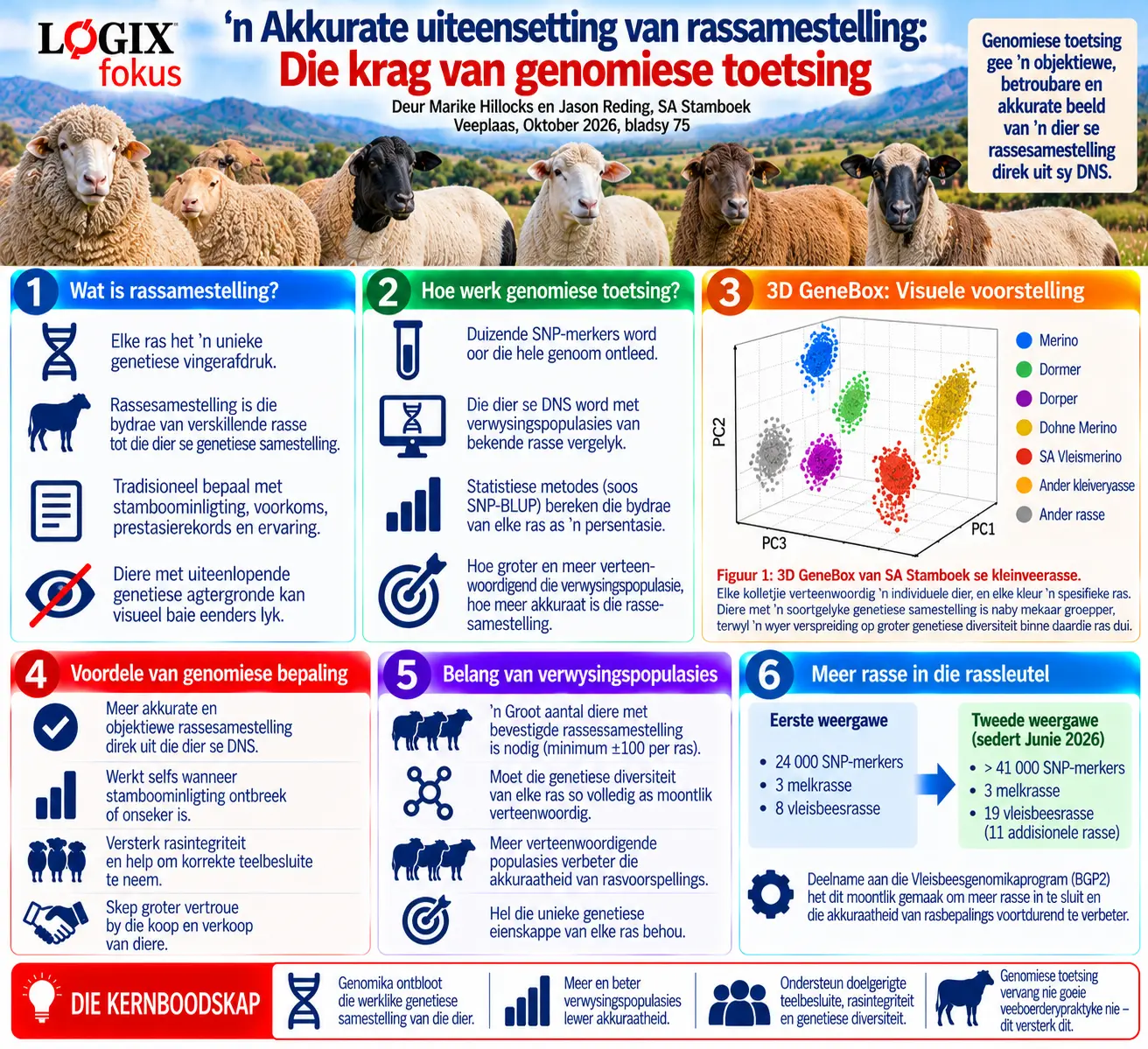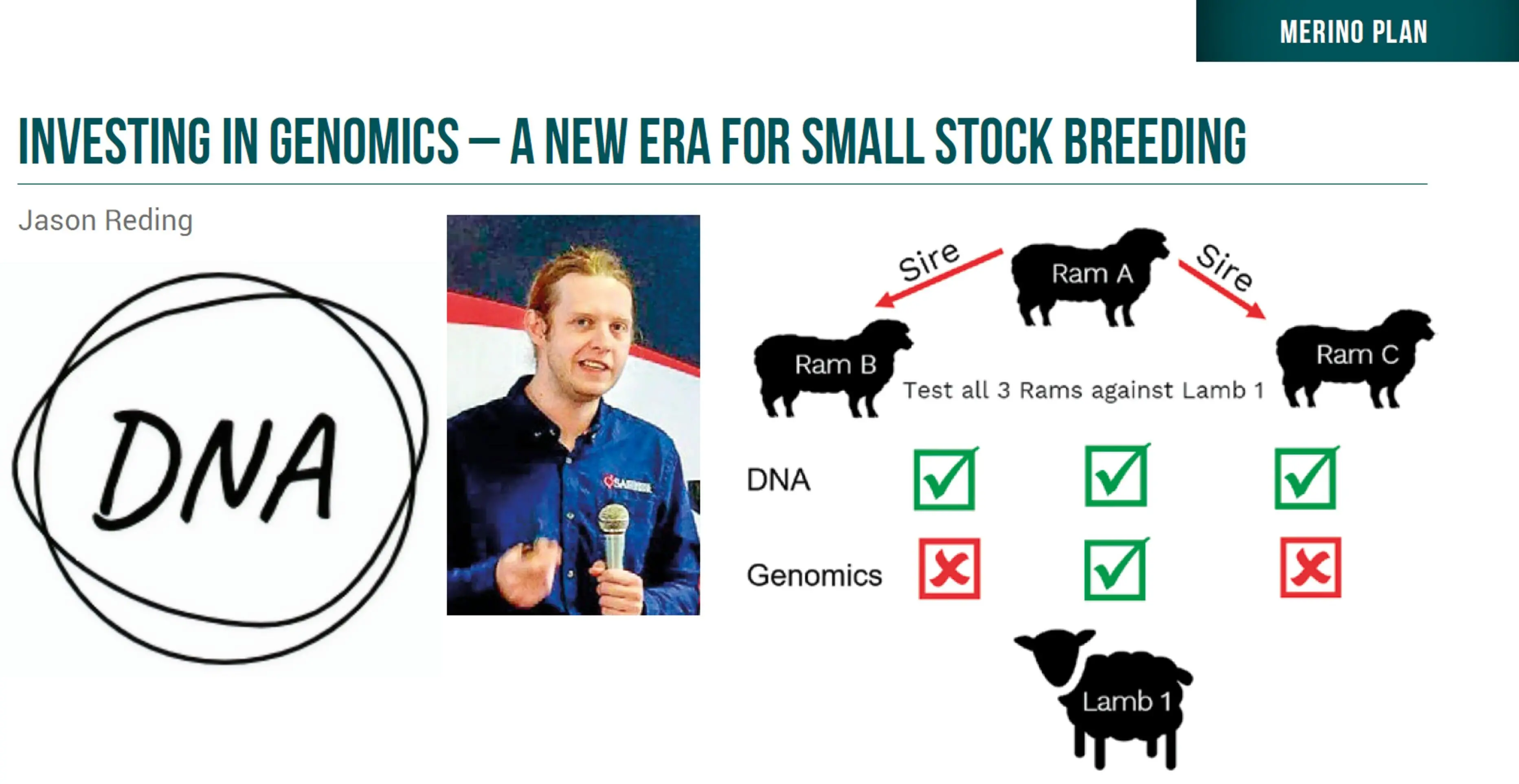
Small Stock breeders need to invest in Genomic technologies. Jason Reding explains exactly why.
Download this publication
PDF · 270 KB · 131 downloads
From the document
Investing in Genomics – A New Era for Small Stock Breeding
Parentage Verification The use of DNA Microsatellite markers for Parentage Verification is widespread across the livestock industry in South Africa, but has limitations that can result in the incorrect identification of an animal’s parentage. The DNA Microsatellite test is not a true confirmation of parentage, but rather an exclusion of who is not the parent. The low number of markers used (12–25) may result in more than one animal being nominated as the possible sire of the tested progeny, especially if a breeder is using rams that are highly related to each other due to a common ancestor.
Table 1: How parentage is determined using opposing homozygotes for genomically tested animals.
enomic services provided to Small Stock breeds associated with SA Stud Book allows breeders to take the next step in boosting the prediction of an animal’s true genetic merit, ensuring pedigree integrity and unravelling the status of single genes within your flock. Breeders unfamiliar with genomics and genomically enhanced breeding values (GEBVs) must be wondering what the benefit of genotyping your stud animals truly is. This short article will hopefully illustrate the impact of genotyping an animal, the effect of parentage verification and how genomics is integrated into a genetic evaluation to enhance the accuracy of breeding values.
25 000 markers (SNPs) to correctly identify the animals that are directly related to each other. Using a stringent 1% mismatch threshold, this means that a parent will be excluded as the true sire when 150 to 250 markers are not in alignment with the progeny they are tested against. The analysis of opposing homozygotes, illustrated in Table 1, allows for the confirmation that the tested animals are indeed directly related to each other.
The concept of opposing homozygotes is simply illustrated above, with two sires being tested against Lamb 1. The genomic marker for an animal can only be AA, AB or BB, with the informative marker being the homozygotes or fixed markers (AA or BB). Sire A is a positive match for all four markers as he can only pass on an A marker to his progeny at SNP 1 and SNP 4, and a B marker at SNP 2 and 3. Sire B has 3/4 conflicts as at SNP 1 he can only pass on the B marker, while Lamb 1 is AA meaning, he has a …
The opening of the PDF. Download it above for the full document.