How can genomic information reveal an animal?s breed composition more objectively than pedigree records or visual assessment alone? This article explains how SA Stud Book?s Breed Key uses thousands of SNP markers and carefully selected genomic reference populations to estimate the contribution of different breeds to an animal?s genetic make-up. It describes the development from Breed Key version 1, using 24,000 SNP markers and 11 breed reference populations, to version 2, using 41,000 markers and adding 11 beef breeds. The article also explains how principal component analysis visualises genetic relationships in a three-dimensional GeneBox, and why estimates become more reliable as reference populations grow and improve.
Download this publication
PDF · 110 KB
From the document
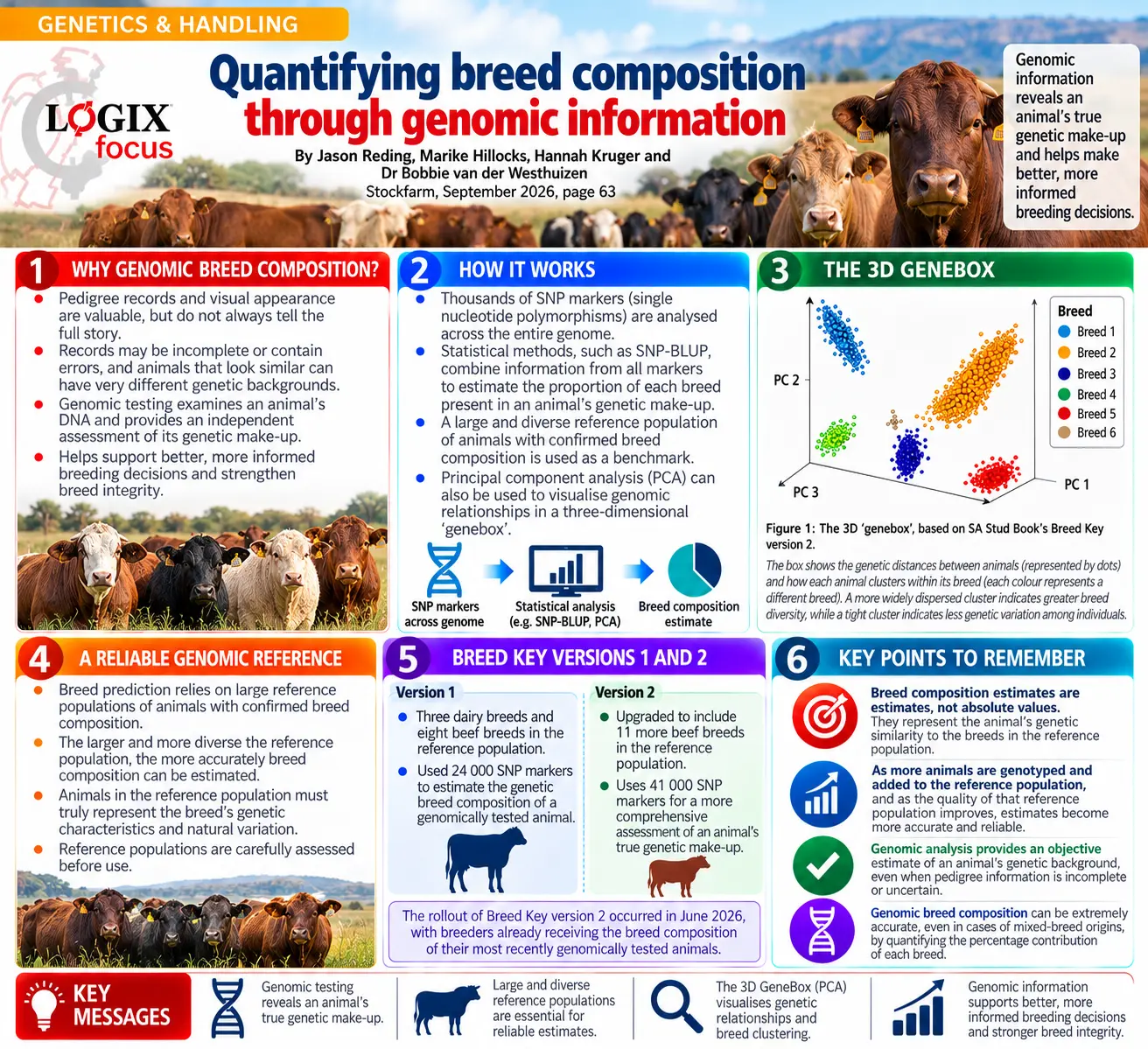
Quantifying breed composition through genomic information By Jason Reding, Marike Hillocks, Hannah Kruger and Dr Bobbie van der Westhuizen
For centuries, breeders only relied on pedigree records and visual appearance to determine an individual animal’s breed composition. While these remain valuable tools, they do not always tell the full story and can be subject to different interpretations. Pedigree records may be incomplete or contain errors, and although animals can look similar, they often have very different genetic backgrounds. Advances in genomic technology now make it possible to examine an animal’s genetic make-up, enabling the estimation of its breed composition with far greater confidence. Every animal inherits a unique DNA pattern from its parents. However, generations of selective breeding have resulted in animals of the same breeds sharing many common DNA characteristics. By comparing an animal’s DNA with that of thousands of animals from known breeds, it is possible to estimate the proportion of each breed present in its genetic make-up.
Figure 1: The 3D ‘genebox’, based on SA Stud Book’s Breed Key version 2.
A reliable genomic reference Breed prediction relies on reference populations, which are large groups of animals whose breed composition has already been confirmed. Their genomic information acts as a benchmark against which other animals are compared. The larger and more diverse the reference population, the more accurately breed composition can be estimated, as it captures the natural variation within each breed while preserving the characteristics that make each breed unique. For this reason, the reference population is carefully assessed to ensure that each breed is represented by animals that reflect its genetic characteristics. Once the reference population has been established, the next step is to compare the test animal’s DNA with this benchmark. Modern genomic testing evaluates thousands of genetic markers spread across the entire genome rather than only a few locations in the DNA code. These markers, known as single nucleotide polymorphisms (SNPs), each provide a small piece of information about the animal’s ancestry. Statistical methods are then used to combine information from all markers to estimate an animal’s breed composition, using SNP-BLUP to obtain the best possible estimate. Evaluation of reference populations can also be done using another statistical method called principal component analysis and visualising the results within a three-dimensional ‘genebox’. The combination of an accurately established reference population, thousands of genomic SNP markers, and advanced statistical analysis provides a powerful tool for …
The opening of the PDF. Download it above for the full document.