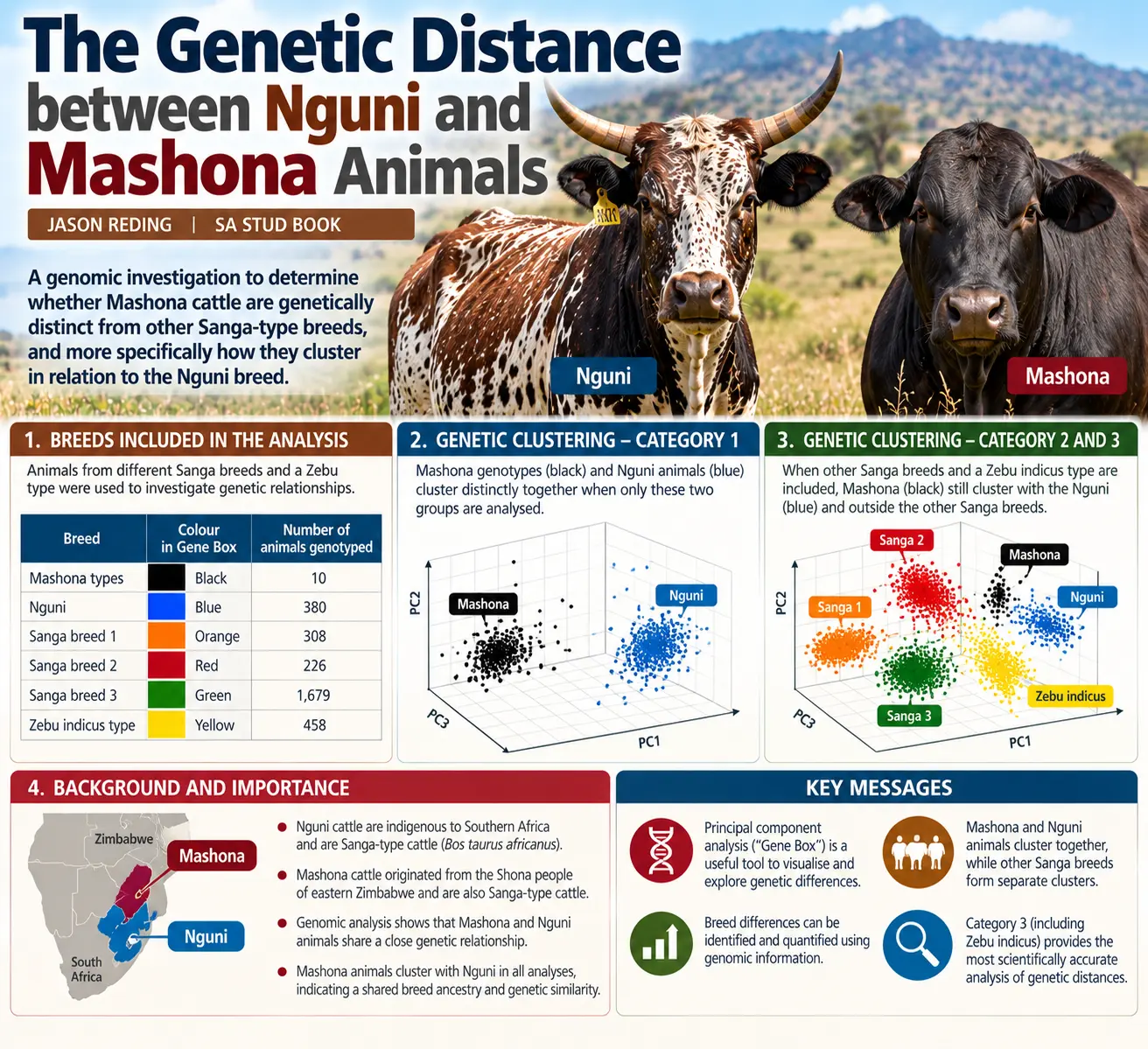
Are Nguni and Mashona cattle genetically distinct, or do they share a common genetic background? Jason Reding investigates this question using genomic data from ten Mashona animals and a three-dimensional GeneBox visualisation based on principal component analysis. By progressively including other South African Sanga breeds and African-origin Zebu cattle, the study explores how genetic relationships become clearer as the reference population expands. The results show that the tested Mashona animals cluster closely with Nguni cattle, indicating genetic similarity and shared ancestry, while also revealing variation among individual animals.
Download this publication
PDF · 470 KB
From the document
The Genetic Distance between Nguni and Mashona Animals JASON REDING
INTRODUCTION anga cattle are indigenous to Southern Africa. Classified as Bos taurus africanus, these cattle are visually distinguishable by their cervico-thoracic humps. The formation of this subspecies is a result of historical crossbreeding between taurine and indicine cattle subspecies in Eastern Africa. The four main Sanga breeds recognised in South Africa include the Afrikaner, Drakensberger, Nguni and Tuli.
migrated further south into
component analysis is used to
visualise and explore the vast
number of genetic variables
in a much simpler format.
the use of this tool, the
cattle ecotypes although cattle
breeds of different genetic
all are essentially still Nguni. Mashona
with Category 3 being the most
from the Shona people of eastern
Zimbabwe and are classified as Sanga type. They are bred in a wide spreading
Table 1 refers to the number of genotypes in each
territory covering most of the eastern half of Zimbabwe
respective breed used in this investigation. Each breed
and an adjoining region of Mozambique that is free of
is distinctly colour-coded in the “Gene box” to easily
the tsetse fly. This breed is reared for meat production,
differentiate between them. The Mashona animal types
and it is said they make docile working animals. A
were colour-coded as black and the Nguni’s as blue.
herd book was established in 1954, after a decade of
The three different Sanga breeds were coded as orange
selection for beef production and polledness. The
(Breed 1), red (Breed 2) and green (Breed 3) with the
Mashona breed is usually black or red and the majority of Mashona are polled.
Zebu indicus type being yellow, respectively.
An investigation into Mashona breed types at a genomic
Table 1: Number of genotypes for each breed and breed type used in the analysis
level was conducted to identify whether these animals are genetically distinct from other Sanga-type breeds,
NUMBER OF ANIMALS GENOTYPED
Breed clustering through a “Gene Box”
Recently ten animals representing Mashona cattle were
genomically tested. These samples were collected and
and more specifically how they cluster in relation to the Nguni breed.
presented for analysis, to assess the level of genetic relatedness as well as shared ancestry between these 10 Mashona genotypes and other Sanga breed genotypes. Setting the course.
analysis of genetic differences between all the animals in
In this scenario, the Mashona genotypes were only
The opening of the PDF. Download it above for the full document.