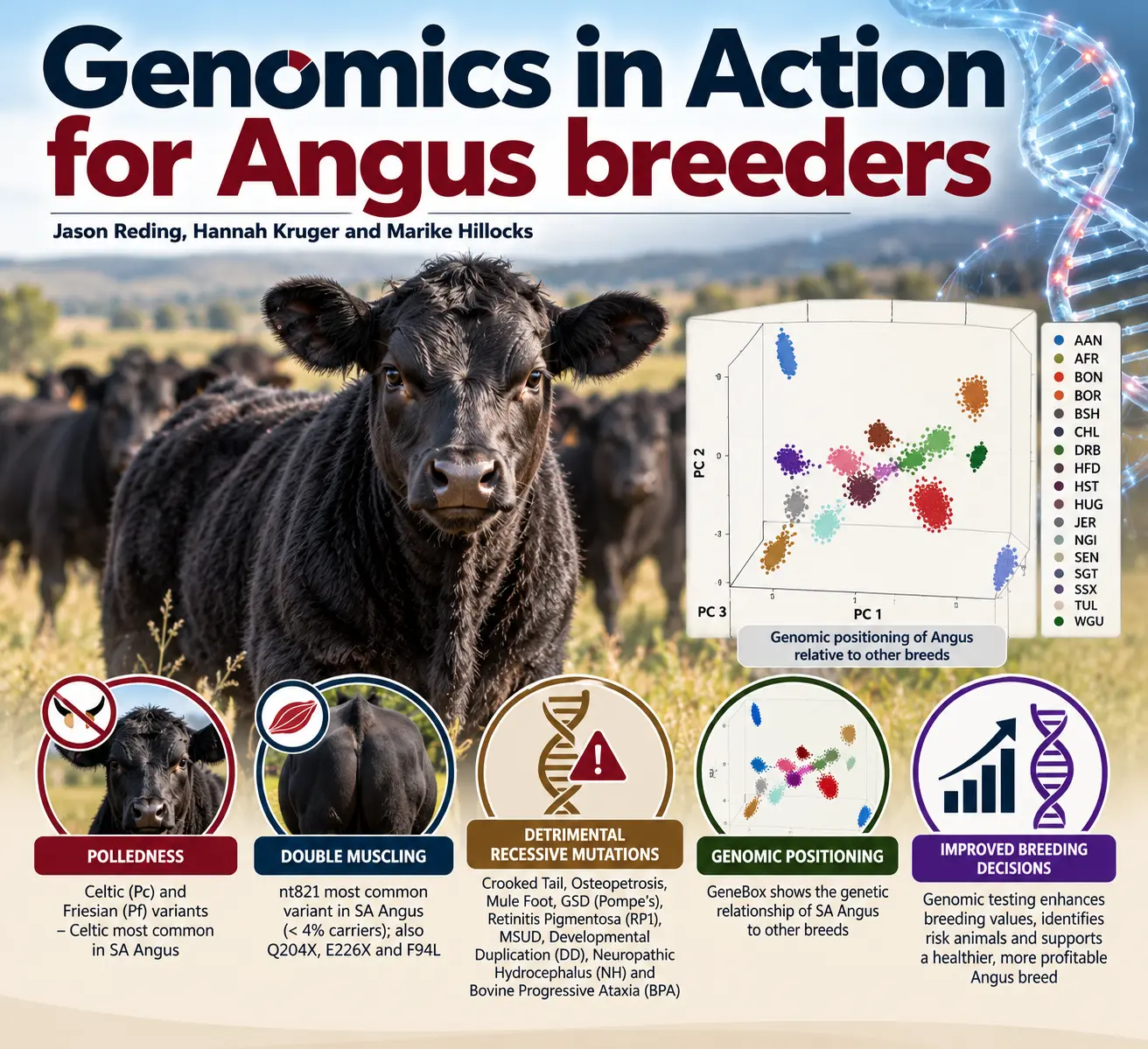
How is genomic testing helping South African Angus breeders make better-informed breeding decisions? This article explores the Angus progress in the Beef Genomics Program (BGP2), including the expansion of its genomic reference population to more than 1,300 animals. It examines the detection of polledness and double-muscling variants, the management of harmful recessive mutations, and the use of GeneBox visualisations to reveal genetic relationships between Angus and other breeds. The article also looks ahead to the role of the Breed Composition Purity Key in tracing breed ancestry and upgrading.
Download this publication
PDF · 484 KB · 1 download
From the document
JOERNAAL 2026 • JOURNAL 2026
Jason Reding, Hannah Kruger and Marike Hillocks
The South African Angus breeders have taken full advantage of the second round of the Beef Genomics Program (BGP2). From the very first year of BGP2, the breed has set the pace by exceeding their allotted genotyping quota by over 300 animals and achieving an impressive 161% compliance rate. The momentum has continued into year two, with the breed on course to reach their allotted quota. This has allowed the breed to grow their genomic reference population to over 1 300 animals. Several herds from breeds registered with SA Stud Book have adopted genomic testing as an essential breeding and management tool. This level of adoption reflects a clear understanding of the long-term value of genomics, allowing the breeders to reap the full benefit of the latest technology. Polledness The two POLLED mutations that can be tested for genomically, are the Celtic (Pc) and Friesian (Pf) variants. The more recently discovered Mongolian (PM) and Guarani (PG) mutations, which also cause polledness, are being investigated by the SA Stud Book team to be provided via a genomic test soon. Genomic testing for both the Celtic and the Friesian POLLED variants has revealed that the Celtic POLLED variant is the only variant segregating in over 98% of the South African Angus population. Double Muscling E226X is the new double-muscling variant that has been found in the South African beef cattle population. Although described as Beef Shorthorn specific, lessons learnt with the “Belgian Blue double-muscling” variant nt821, these mutations can sporadically occur in other breeds. Less than 4% of the total SA Angus population tests as a carrier, with the nt821 variant having been identified as the primary variant segregating within the SA Angus population (Figure 1). In the cases where an animal is a carrier, of either nt821, Q204X or F94L, it has been traced back to cows brought in as Section A for upgrading purposes. This highlights a need to screen these animals to reveal their double-muscling status prior to considering them, with the added benefit of genomically enhanced breeding values assisting the prediction of their breeding potential.
Figure 1. Double muscling gene variants found within the South African Angus population.
JOERNAAL 2026 • JOURNAL 2026
Detrimental Recessive Mutations Genetic disorders such as Crooked Tail, Osteopetrosis, and Mule Foot cause distinctive phenotypic abnormalities, often mistaken for general weakness or …
The opening of the PDF. Download it above for the full document.