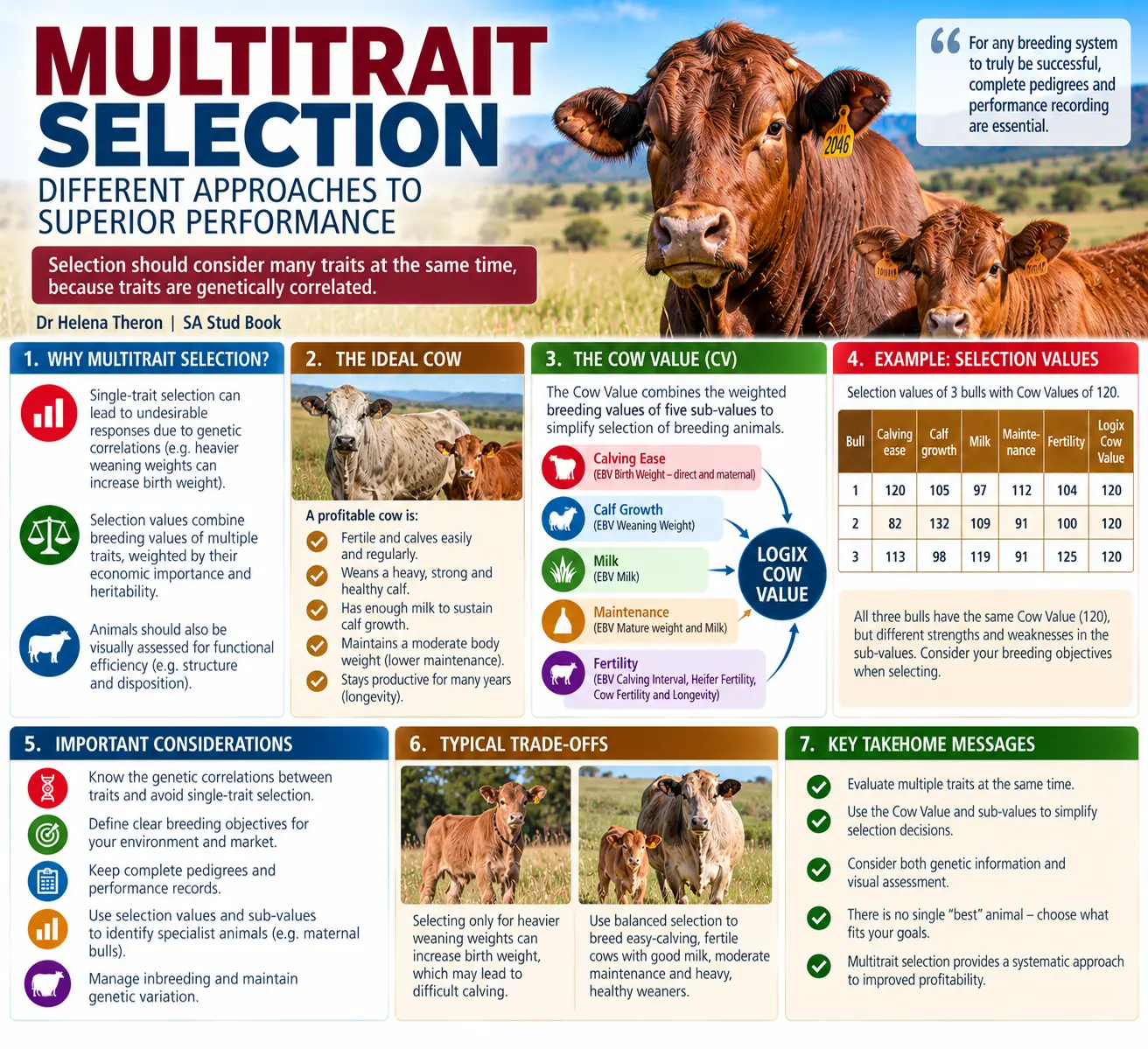
Can two bulls with identical Cow Values produce very different results? Dr Helena Theron explains why selecting beef cattle for a single trait can lead to undesirable genetic consequences and how multitrait selection offers a more balanced approach. Using SA Stud Book?s Logix Cow Value and its five component values, she demonstrates how fertility, calving ease, calf growth, milk production and maintenance requirements can be combined according to their economic importance. A practical comparison of three bulls with identical overall Cow Values reveals why examining individual component values is essential for choosing the most suitable breeding animals.
Download this publication
PDF · 204 KB · 2 downloads
From the document
MULTITRAIT SELECTION DR HELENA THERON
SA STUD BOOK | PRETORIA OFFICE
eef cattle breeders sometimes find it difficult to know which individuals would be ‘best’ to become the parents of the next generation. Selection involves the
evaluation of potential parents on functional efficiency, as well as many production traits, and some compromises among these traits are also needed. Selection in beef cattle on single traits is not advisable due to negative correlations between traits. For example, if cattle are selected only on weaning weight, chances are very good that cattle will become larger and birth weights become heavier, which might lead to difficult births. The solution to this problem is a multitrait selection – by selecting bulls that breed calves that wean heavy calves but not too heavy at birth. This is a simple example, but in practice, things could get much more complicated: heavy weaners are also dependant on cows with high milk production, etc. Setting the course.
One of the methods used to simplify the selection and
values of these traits in a single value. However, to see
select for multiple traits at once is to use a selection
the various strengths and weaknesses of an animal, the
value, which combines breeding values of different
Cow Value (CV) is made up of the sub-values Calving
traits into a single value. However, breeding values
Ease, Calf Growth, Milk, Female Fertility and Maintenance.
cannot simply be added together: some traits are
Sub-values scientifically combine similar breeding values
economically more important and heritabilities
to simplify the selection of animals. For example, the
of traits differ. Each trait is therefore scientifically
EBVs for Heifer Fertility, Cow Fertility and Longevity are
weighed. Selection values take the advantages
combined to form the sub-value Fertility by taking the
and disadvantages of traits into consideration in a
heritability and economic importance into consideration.
balanced way. In addition to selection on production
By using the sub-values, it is also easier to identify
traits by using selection values, animals should also be
specialist bulls, for example, maternal bulls (daughters will
visually inspected for functional efficiency traits like
raise a profitable calf every year). It is therefore essential to
structural soundness and disposition.
evaluate the sub-values for the Cow Value when selecting potential breeding bulls.
Breeding the perfect cow What are the characteristics of a perfect cow? She
is fertile, calves easily and regularly, weans a heavy,
The opening of the PDF. Download it above for the full document.