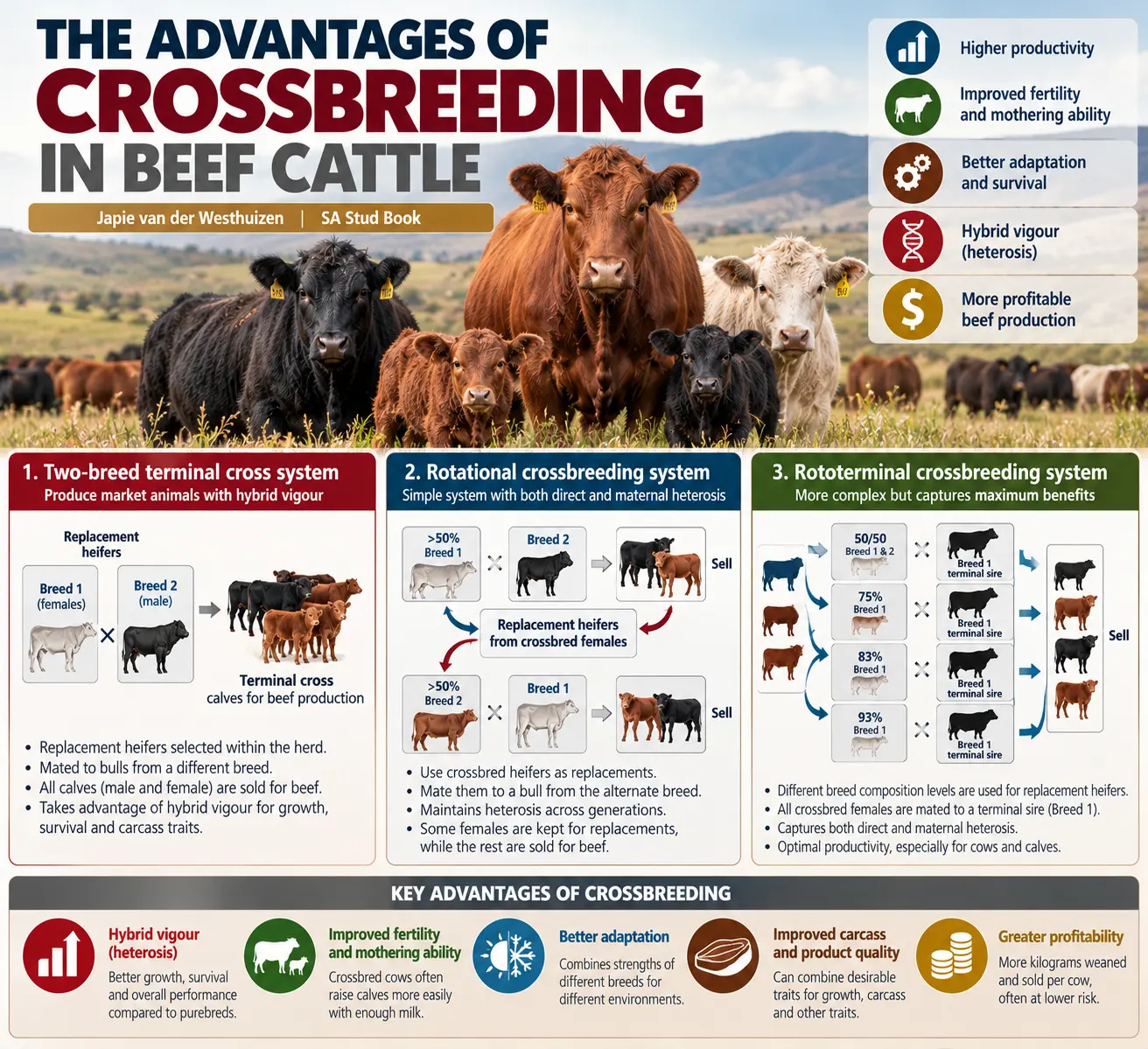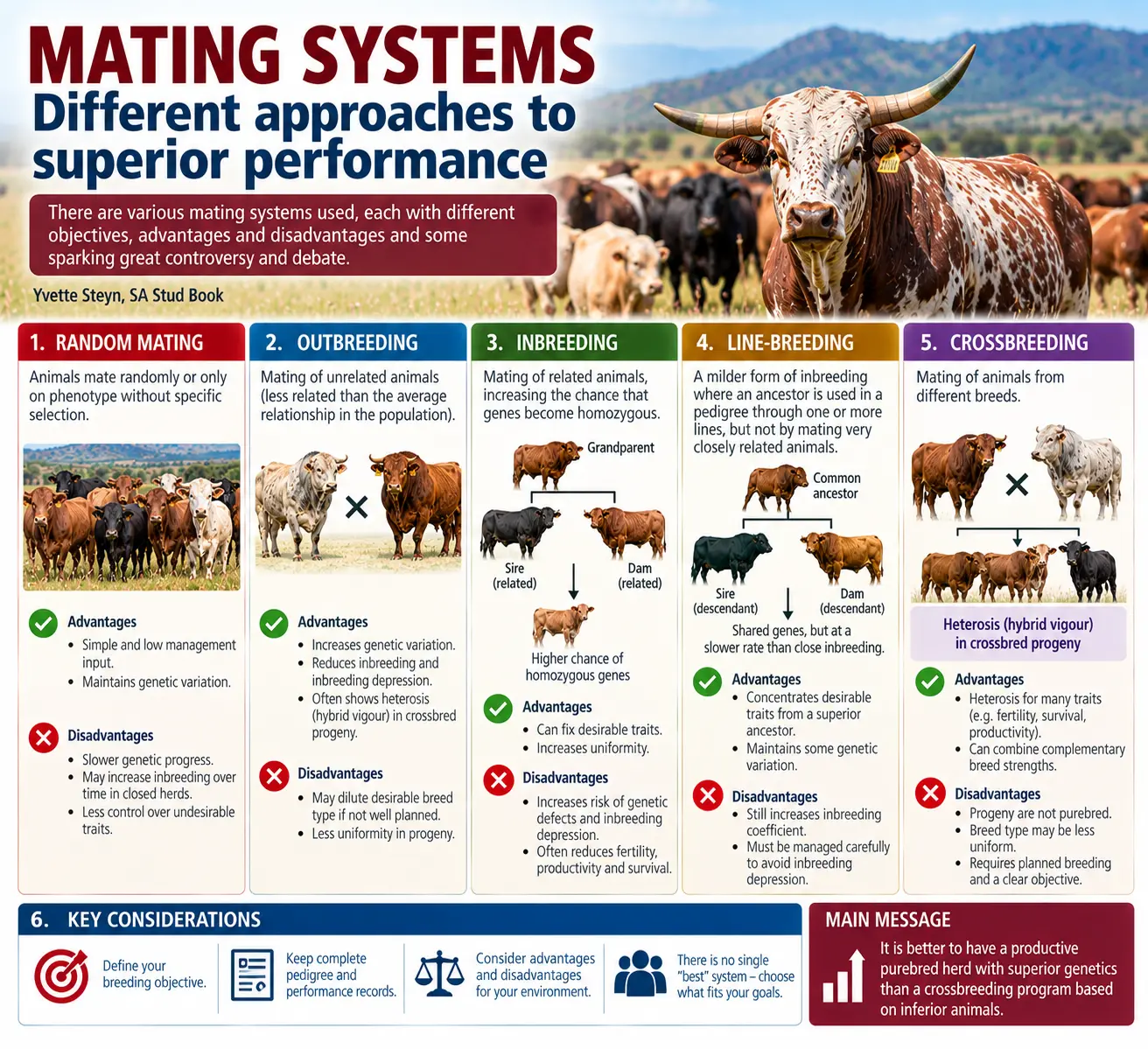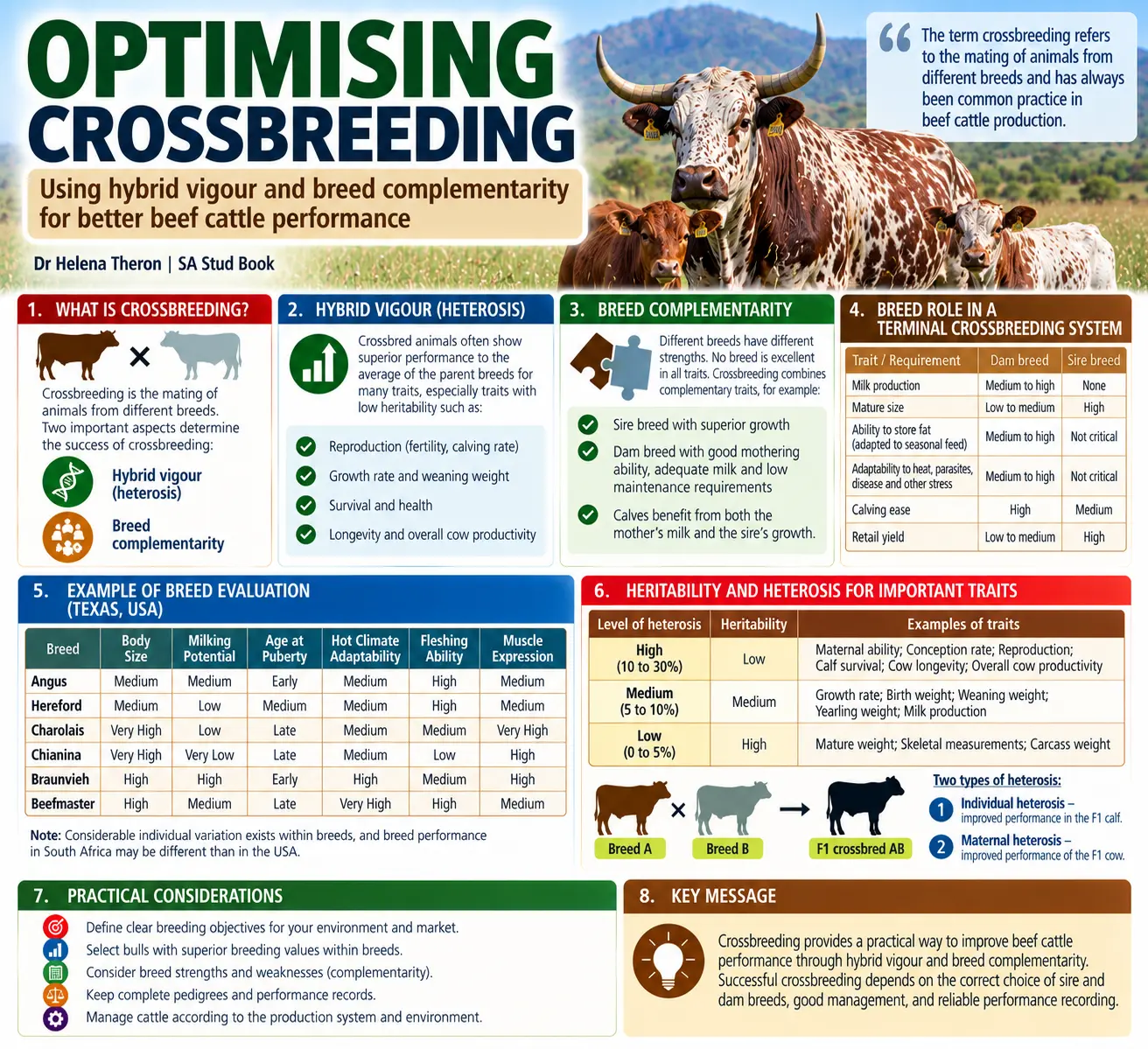
How can beef producers combine the strengths of different breeds to improve lifetime productivity and profitability? Dr Helena Theron explains the complementary roles of heterosis (hybrid vigour) and breed complementarity, using Nguni cattle as an example of an adapted maternal breed. The article compares two-breed terminal, two-breed rotational and three-breed roto-terminal crossbreeding systems, explaining how they differ in the use of individual and maternal heterosis, replacement heifers and terminal sires. It emphasises that successful crossbreeding requires a planned mating system, suitable breeds for the production environment, and bulls selected on breeding values for the traits that matter.
Download this publication
PDF · 469 KB
From the document
Optimising D R H E L E N A T H E R O N | SA Stud Book
he term crossbreeding refers
Although all breeds are superior for some of the
from different breeds and
economically important traits, no breed is excellent
complementarity, where the strengths of one breed
in all traits. Crossbreeding takes advantage of breed complement or mask the weaknesses of another breed. In
practice in beef cattle production. Two
a Terminal Crossbreeding system,
aspects need to be considered to get
for example, a bull from a breed
the best advantage from crossbreeding,
small-framed, low maintenance
with superior growth is used on
namely hybrid vigour (heterosis) and
cows with good mothering ability
breed complementarity, which is often
then have both the advantage of the
and adequate milk (Table 1). Calves mother’s milk and the sire’s growth.
overlooked. Setting the course.
CROSSBREEDING TABLE 1: Breed Role in a Terminal Crossbreeding
The choice of both the sire and dam breed is therefore
System (Adapted from www.omafra.gov.on.ca)
important, and the more different the parental breeds are, the more heterosis would be expected from the
Ability to store fat and regulate energy requirements
mating. The Nguni is well-known as a mother line and
with changing (seasonal) availability of feed.
performs well in crossbreeding systems, as was shown
2 Physiologic tolerance to heat, cold, internal and external
in a study by Scholtz and Theunissen, where Nguni cows were crossed with Simmentaler, Charolais and
parasites, disease, mud and other stress.
Chianina sires. They found that calving difficulties were limited, and birth weights were restricted to the midparent value or below. Crossbreeding did not have a
negative effect on cow performance such as weight
most cases, the weaning weight of cross-bred calves
and the feed conversion ratio was always better than
change and fertility, but cow productivity increased. In was the same or exceeded that of the pure sire breed, either of the two parent breeds.
In Table 2 is examples of the performance of some breeds. It would, however, be advisable to not only look at breed characteristics but also select bulls on superior breeding values as there is a lot of variability found within breeds as well. TABLE 2: Example of breed evaluation for cattle breeds in Texas, USA. Note that considerable individual variation exists within breeds, and breed performance in South Africa may be different than in the USA (http://animalscience.tamu.edu/). Breed …
The opening of the PDF. Download it above for the full document.