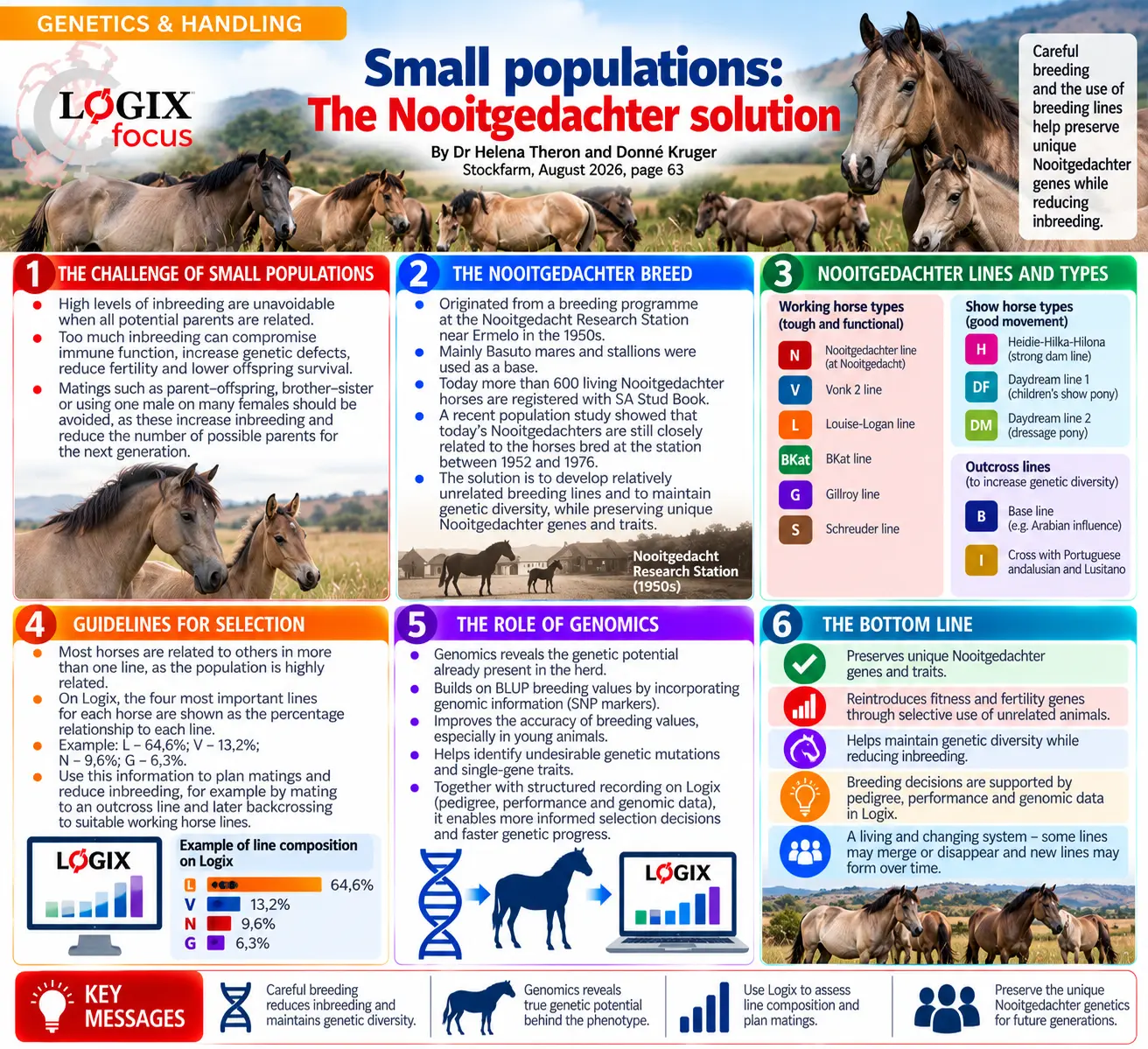
How can a small, closely related horse population reduce inbreeding while preserving its unique genetic identity? This article describes how Nooitgedachter breeders use defined genetic lines, identified through pedigree analysis with the optiSel programme, to understand relationships to important ancestors and make more informed mating decisions. It explains the roles of working-horse, show-horse and outcross lines, including the Base and Iberian lines, in maintaining genetic diversity. Using line-relationship percentages in SA Stud Book?s Logix system, breeders can identify suitable mating options to reduce inbreeding while retaining valuable Nooitgedachter characteristics, including fitness, fertility and survival.
Download this publication
PDF · 104 KB
From the document
Small populations: The Nooitgedachter solution By Dr Helena Theron and Donné Kruger
igh levels of inbreeding are unavoidable when all potential parents in a breed are related. When inbreeding becomes too high, it compromises immune function and increases genetic defects, leading to reduced fertility, and lower offspring survival. Matings should therefore be carefully planned beforehand. For example, parent-offspring, brother-sister, or even a single male used on many females must be avoided, as it substantially increases inbreeding in subsequent generations and reduces the number of possible parents for the next generation.
The Nooitgedachter breed The Nooitgedachter horse breed originated from a breeding programme for indigenously adapted horses at the Nooitgedacht Research Station near Ermelo in the 1950s. Mainly Basuto mares and stallions were used as a base. A recent population study conducted by SA Stud Book has shown that today’s Nooitgedachters are still closely related to the horses bred at the Nooitgedacht Research Station between 1952 and 1976. Some of the original Basuto mares, together with one of the original stallions, Vonk 2, continue to play a significant genetic role in the breed. Today, more than 600 living Nooitgedachter horses are registered with SA Stud Book. Although numerous theoretical solutions exist for reducing and controlling levels of inbreeding, most are not practical. One possible solution is the development of relatively unrelated breeding lines. This aligns with the shared goal of breeders to preserve the Nooitgedachter by reducing inbreeding and maintaining genetic diversity.
It remains important that unique Nooitgedachter genes and traits are preserved and continuously selected for. However, genes related to fitness and fertility – traits that are usually the first lost through inbreeding – can be reintroduced from outside by selectively using unrelated animals.
Nooitgedachter lines Breeders divided the Nooitgedachter population into existing lines and types and identified important ancestors in each line as anchor animals. The relationship of living animals to these anchors was determined using the optiSel genetic analysis program. For example, the N (Nooitgedachter) line consists of horses born at the Nooitgedacht Research Station. The optiSel program was used to calculate the percentage relationship of the current horses to the original Nooitgedachter animals by means of pedigree contributions. The same principle was used for the other identified lines. The identified working horse types are tough, functional farm horses with good endurance, and includes the N (Nooitgedachter), V (Vonk 2), L (LouiseLogan), BKat, G (Gillroy), and the S …
The opening of the PDF. Download it above for the full document.