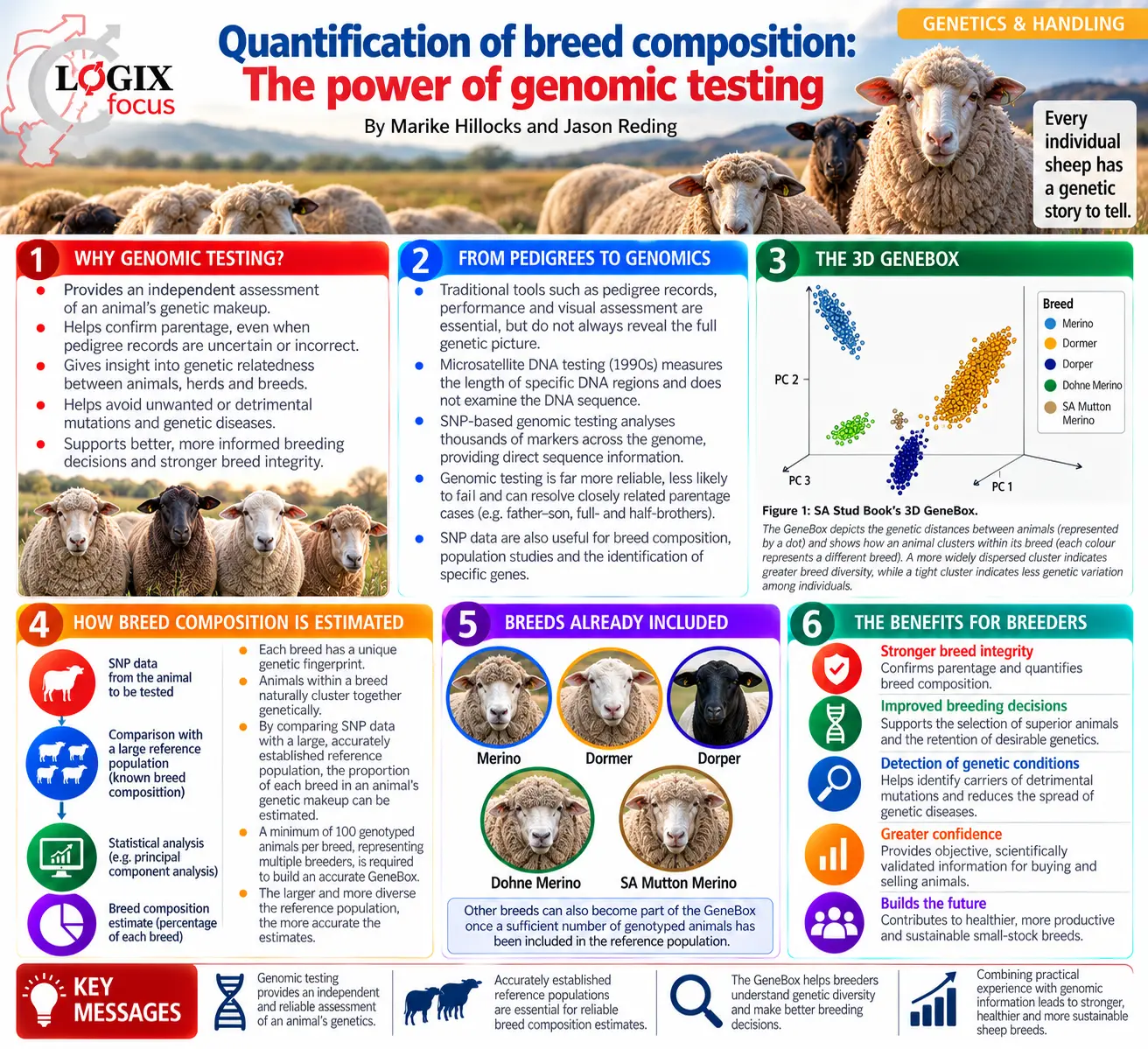
How can genomic testing reveal an animal?s true breed composition when pedigrees are incomplete or uncertain? This article introduces SA Stud Book?s 3D GeneBox and Breed Key, which use thousands of SNP markers and a representative reference population to estimate the genetic contribution of different breeds in individual sheep. It explains why reference populations must be sufficiently large and diverse, and how genomic information can help verify breed composition, assess genetic relationships, confirm parentage and identify potentially harmful mutations. The article highlights the breeds already positioned to benefit from the GeneBox, including Merino, Dormer, Dorper, Dohne Merino and SA Mutton Merino.
Download this publication
PDF · 2.5 MB · 1 download
From the document
Quantification of breed composition: The power of genomic testing By Marike Hillocks and Jason Reding
Every individual sheep in your flock has a story to tell, hidden in its DNA. The question is: Are you listening? For generations, breeders have relied on pedigree records, performance, visual assessment and experience to make breeding decisions. While these are essential tools, they do not always reveal the complete genetic picture. Recording errors do occur, parentage may sometimes be uncertain, and animals with identical pedigrees can inherit very different combinations of genes from their parents. Two sheep may look alike but have completely different genetic backgrounds. Today, genomic technology allows us to look directly at an animal’s DNA – the genetic code that makes each animal unique. This provides valuable information that, when used correctly, can improve breeding decisions, strengthen breed integrity and add confidence when buying or selling animals. By analysing thousands of genetic markers, known as single-nucleotide polymorphisms (SNPs), distributed across the entire genome, genomics provides an independent assessment of the animal’s genetic makeup.
Why test animals? Whether you run a stud or a commercial flock, every breeding decision has an impact on the future of your flock. Selecting the right rams and replacement ewes determines which genetics remain in the flock for years to come. Genomic knowledge simply provides another piece of information to support these decisions. Genomic testing can help you confirm parentage, gain insight into the genetic relatedness between animals, herds, and breeds, and avoid unwanted or detrimental mutations/diseases.
Introducing the GeneBox Every breed has its own unique genetic fingerprint, just as every animal carries a unique DNA pattern inherited from its parents. Selective breeding over many generations has resulted in animals in the same breed sharing many common DNA characteristics. As a result, they naturally cluster together genetically. By comparing an animal’s DNA code with a large reference population – animals whose breed composition has already been confirmed – it is possible to estimate the proportion of each breed present in its genetic make-up. The reference population acts as a benchmark against which other animals are compared. The larger and more representative (diverse) the reference population, the more accurately breed composition can be estimated. The reference population is carefully assessed to ensure that each breed is represented by animals that truly reflect its genetic characteristics. By combining information from all the SNP markers, the system can estimate an …
The opening of the PDF. Download it above for the full document.