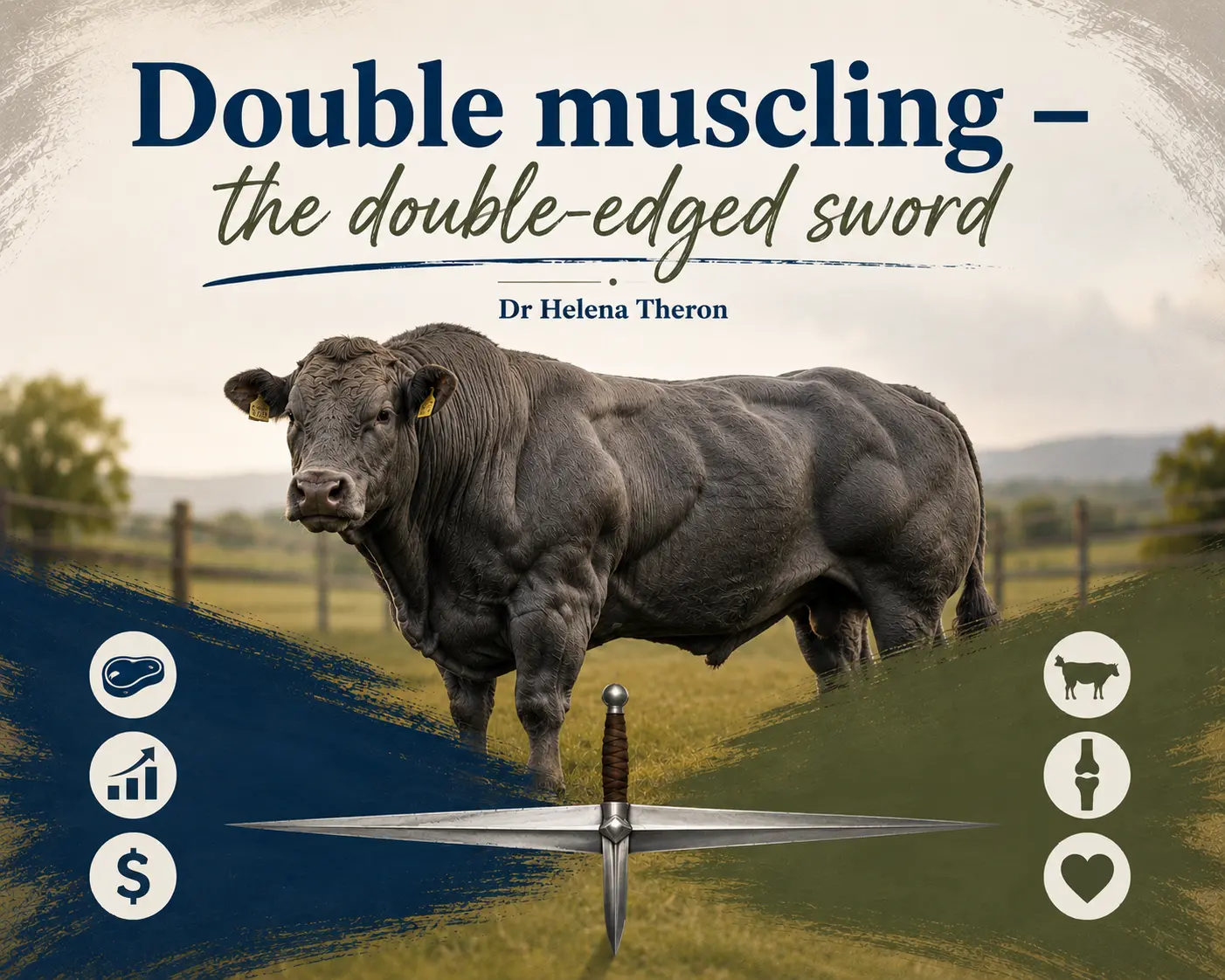
Hannah Kruger explains how double muscling is inherited in beef cattle
Download this publication
PDF · 180 KB · 69 downloads
From the document
HANNAH KRUGER - SA Stud Book, hannah@studbook.co.za
The myostatin protein regulates normal growth and development of muscle in an animal’s body. A few mutations in the gene responsible for the synthesis of this protein can disrupt myostatin’s ability to function normally, causing muscles to grow uncontrollably, resulting in an animal being double-muscled. The Q204X and nt821 mutations
SANTA GERTRUDIS | Joernaal 2025
cause a break in the myostatin protein, and affected animals will be double-muscled. The F94L mutation doesn’t break the myostatin protein, but rather affects its ability to bind to muscles and ensure normal muscling. Mutations such as the, so called “green genes” appear to have very small or neutral effects when on its own but an
As seen in Figure 2 when you mate a carrier of a myostatin mutation (Aa) to a “mutation free” (AA) animal it results in 50% of the progeny being carriers of the mutation (Aa).
(compounding) additive effect is seen when more than one myostatin mutation is inherited together. This combination may cause undesired effects on traits such as fertility. These genes are currently being tested for their true effect once sufficient numbers of animals have been genotyped for accurate results. These mutations behave recessively, meaning it is almost impossible to identify carriers of double-muscling mutations, as they only appear in an affected calf, which is a result of mating two carrier animals (Figure 4).
Figure 3 shows the mating between a homozygous “wild-type” (AA) (dam) and a homozygous carrier (aa) (sire). Figure 3 Punnett square of mating between a homozygote “free” and homozygous carrier Sire
All the myostatin mutations are single gene mutations which follow simple mendelian inheritance. In this inheritance pattern the animal can either be a homozygote (two copies of the same variant) or heterozygote (two different variants). One copy of each variant is inherited from the sire and the dam. When an animals is homozygous for the “normal”/ “wild-type”/”free” it is reported as a AA or 0, when an animal is heterozygous for a mutation meaning it has one “normal” and one mutation variant then it is given a Aa or a 1 and if it is homozygous for a mutation meaning it carries two copies of the mutation then it is given a aa or 2 in the report. Figure 1 is a punnett square which shows how the inheritance will occur when an animal homozygous for the …
The opening of the PDF. Download it above for the full document.