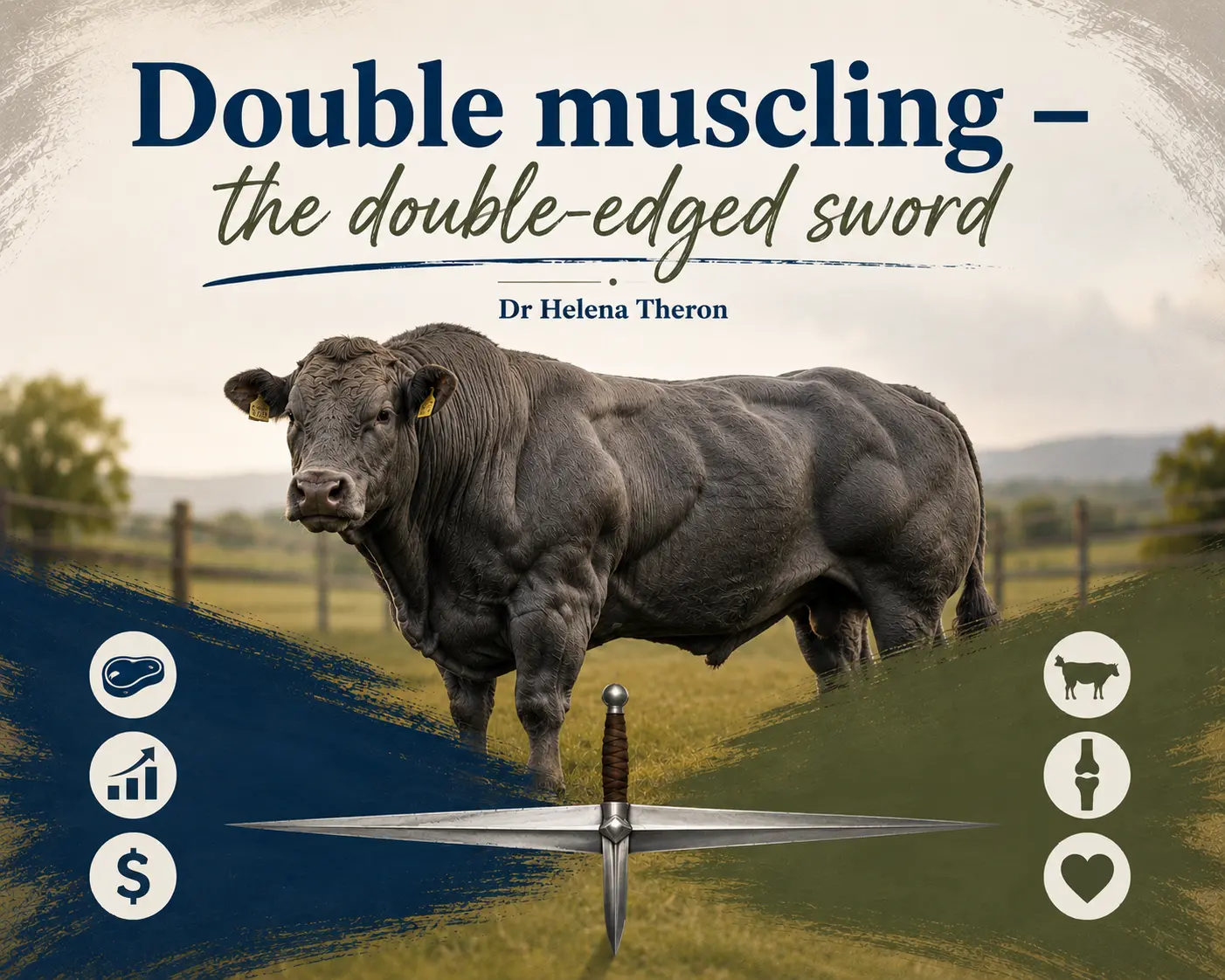
Although some European systems make use of double muscling, it is usually not desirable and is not even tolerated in South African livestock farming.
Download this publication
PDF · 5.2 MB · 37 downloads
From the document
Double muscling – the double-edged sword Double-muscled animals are highly sought after in some production systems in Europe. A double-muscled animal has about 20% more meat and an excellent dressing percentage of around 50% due to less fat, organs, and bone. There are several European cattle breeds in which numerous mutations cause homozygous double muscling (carrying two similar double-musclingcausing alleles of the gene), including the Belgian Blue, Maine Anjou, Marchigiana, Piedmontese, Aubrac, and various other breeds. The doublemuscled European breeds have also been selected over the years for additional muscling genes. If the detrimental myostatin (MSTN) mutations therefore occur in an unrelated breed, the effect on muscling is not nearly as severe as it is in, for example, the Belgian Blue.
An advertisement for semen of a doublemuscled Belgian Blue bull.
In these European production systems, double-muscled animals are kept in small herds, which allows them to receive the special feed and specific care and attention they require due to various health issues associated with the condition. Calves are marketed as veal before weaning. Calving difficulties caused significant issues before caesarean sections became common. Less detrimental variants, such as F94L, were marketed as the ‘profit gene’ because they cause double muscling, but without the high birthweights. Thus, double-muscled animals have a place under specific circumstances and production systems, mainly in Europe. However, they are ill-suited to extensive production systems in South Africa, the USA, and Australia, primarily because of the cows’ inability to calve naturally and the specialised nutrition and care they require. The question then remains: why did the detrimental mutations nt821 and Q204X spread through beef cattle breeds in South Africa? Partial recessiveness MSTN mutations are partially recessive (showing ‘incomplete penetrance’). If an animal inherits a normal myostatin gene from one parent and a detrimental myostatin mutation from the other (heterozygous/carrier), it can display degrees of double muscling or exhibit some traits of double muscling and not others. The reason for this is likely interactions with other unknown genes or the environment.
A carrier of nt821 (left showing prominent muscle development and a free bull right).
Carriers of Q204X (left) and nt821 (right), which show good muscle definition.
Carrier bulls display good muscle definition due to more muscle cells and less subcutaneous fat, giving them a selection advantage. As carrier bulls were increasingly selected as breeding bulls, the frequency of the detrimental MSTN mutations also increased in many …
The opening of the PDF. Download it above for the full document.