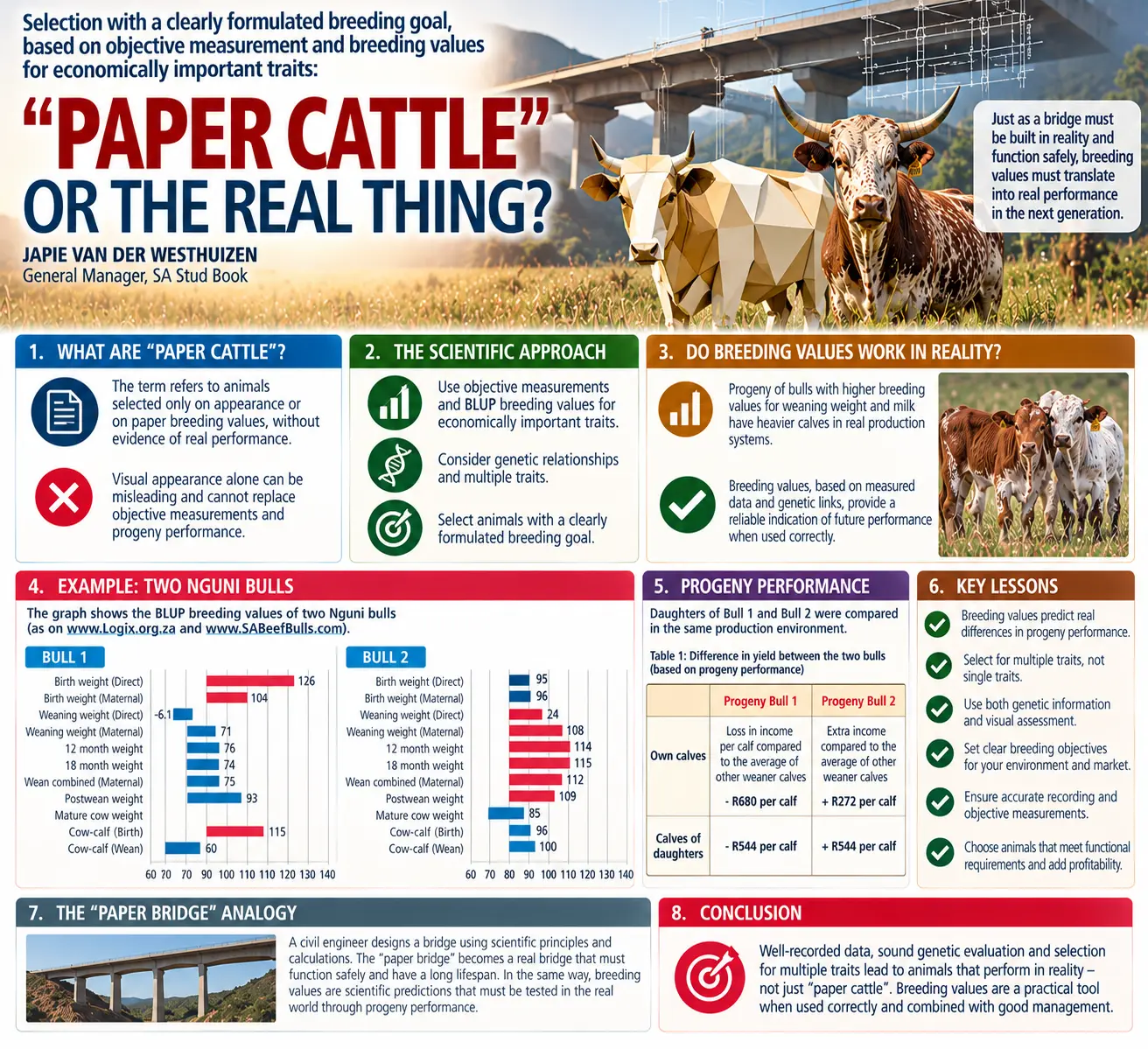
A perspective of BLUP breeding values and how to interpret them, also in terms of performance in differing environments
Download this publication
PDF · 284 KB · 32 downloads
From the document
Breeding objectives in different environments
by Japie van der Westhuizen, SA Stud Book and Animal Improvement Association
he most important equation in animal breeding relates to the two main influences on differences in performance among animals, namely the environment and the genetic merit of each individual animal. The challenge is therefore to separate these two components so that the true genetic merit of each animal for each trait of economic importance can be known. The rate of selection progress depends on an interwoven set of factors, namely the variance in genetic differences among the animals available for selection, the ability to accurately determine the transferrable genetic merit of each animal (the breeding value) and the proportion of the animals kept as parents for the next generation.
Measuring selection Successful selection can be measured in terms of the rate of replacing a generation with one that will ensure more profit within the constraints of the practiced production system. The first notion will therefore be to select animals in exactly the same environmental influences that the progeny have to perform. Although this might be a noble idea, it is not practical as environmental changes over time (on the same farm or locality) cannot be catered for (except in environmentally controlled environments like in-house chicken units or similar systems). So, in essence no extensive livestock recording system (or for that matter any other livestock system) can claim selection within the environment of where breeding stock is kept to be identical, or even similar to the environment where the progeny have to perform. This is sometimes even more complicated where some scientific studies indicate relative low or no correlation between performance at low input systems versus high energy diets (like in feedlots). The question is: “Is it possible to select effectively where it is known that the progeny has to perform well in a different environment to where the breeding animals are kept?” Numerous studies and genetic progress in many countries and diverse environments show that this is in fact possible, given that the diversity in environments is within reasonable bounds. Recording and selection strategies can also be applied to make sure all aspects are covered. Breeders and other producers should also make use of other aids, and sometimes common sense in selecting the desirable breeding animals.
“Real” genotype vs perceived interactions Sometimes preconceived ideas or old habits dictate that a geno-
The opening of the PDF. Download it above for the full document.