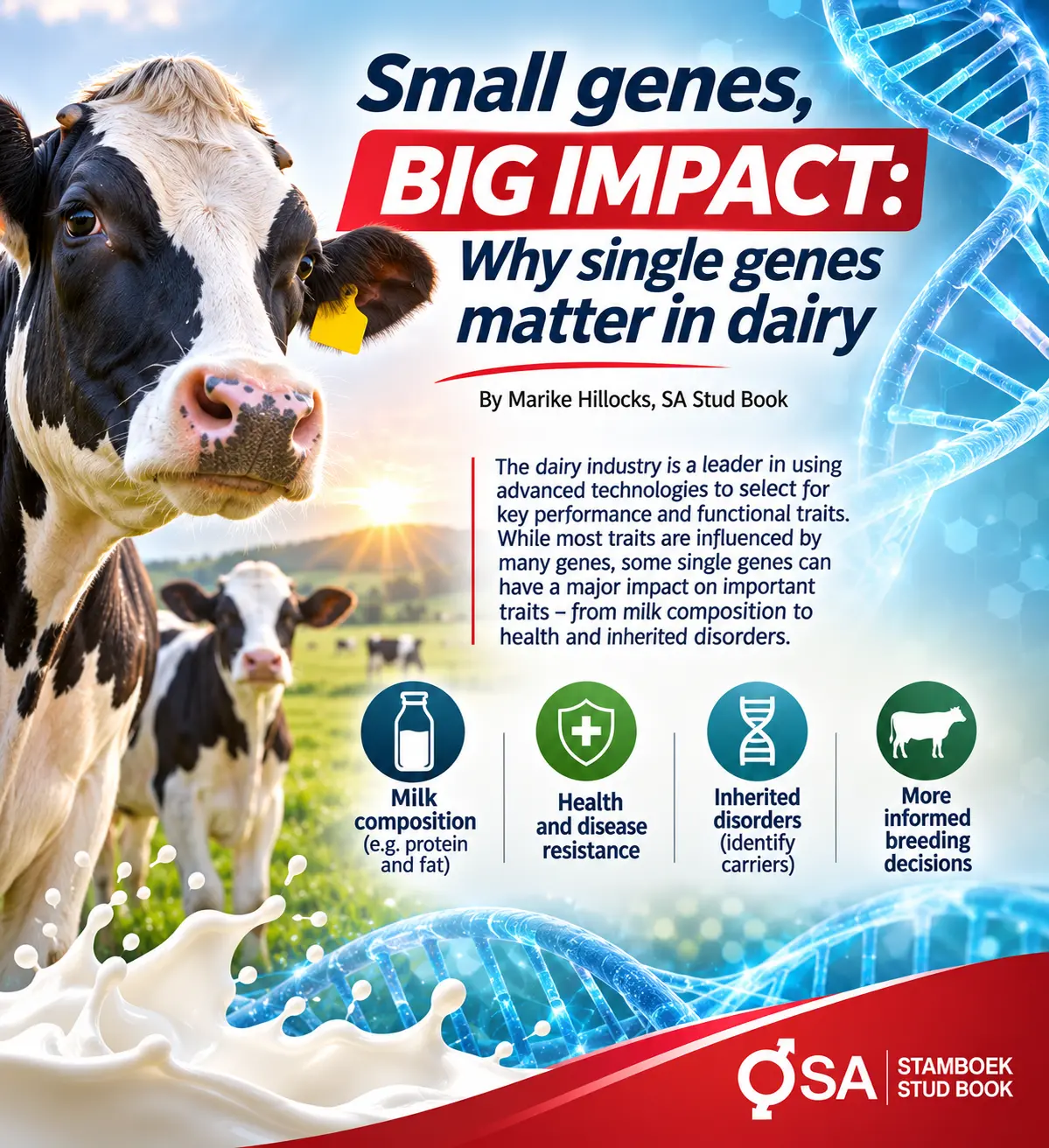
Some genetic differences have a much larger effect than others. This article explains why single-gene mutations matter in dairy cattle breeding, from milk composition and polledness to inherited disorders. It explores important milk-related genes, including ABCG2, DGAT1, beta-casein, kappa-casein and beta-lactoglobulin, and explains how recessive mutations can remain hidden in apparently normal carrier animals. The article also describes how genomic testing helps breeders identify carriers, manage mating risks and protect animal welfare. Beyond single-gene testing, one genomic test can also support parentage verification, more accurate assessment of inbreeding, breed-composition analysis and the prediction of an animal?s genetic value under South African conditions.
Download this publication
PDF · 1.7 MB
From the document
Small genes, BIG IMPACT: Why single genes matter in dairy by Marike Hillocks, SA Stud Book
The dairy industry is one of the leaders in using advanced technologies to select cattle based on performance and functional traits such as milk yield, fertility, udder structure, feet and leg properties, longevity and others. These traits remain the foundation of successful dairy production and are typically influenced by many different genes working together (additively, with each gene having a small effect). However, in some cases, single genes can have a profound impact on the expression of certain traits.
ne of the most important advances in modern livestock breeding is the ability to accurately identify each animal’s unique DNA profile (the code determining the genetic influence on differences among individuals). This helps
60 THE DAIRYMAIL • MAY 2026
breeders understand valuable traits, identify possible health risks, and predict more accurately what an animal may pass on to future generations. It also makes it possible to detect important single-gene mutations within a herd.
NAVORSING EN OPLEIDING • RESEARCH AND TRAINING
Single genes A single genetic mutation (a random permanent change in an animal’s DNA sequence that arises by itself or through outside influences and is carried over to the next generation) can influence whether a cow produces milk more (or less) efficiently, yields higher milk protein percentages, tolerates heat better, or carries a hereditary defect. Every animal carries a genetic “instruction manual” in each of its cells – its DNA – which influences how it looks, grows and functions. Most production traits are controlled by many genes, each contributing a small effect. These are known as polygenic traits. Single genes, however, work differently. A mutation in one gene can have a major – and sometimes immediate – effect on the expression of a trait. Occasionally, genes can mutate, leading to an alteration in the expression of a very specific trait, resulting in differences from the normal appearance or performance of animals. These observations or recordings are known as phenotypes. Each animal inherits two copies of every gene – one from each parent. These copies may be identical (homozygous) or different (heterozygous). In many cases, harmful mutations are recessive, meaning that one form of the
gene is dominant (usually the favourable or “normal” variant) and masks the effect of the other. In these cases: » Animals with two normal copies (BB) are unaffected » Animals with …
The opening of the PDF. Download it above for the full document.