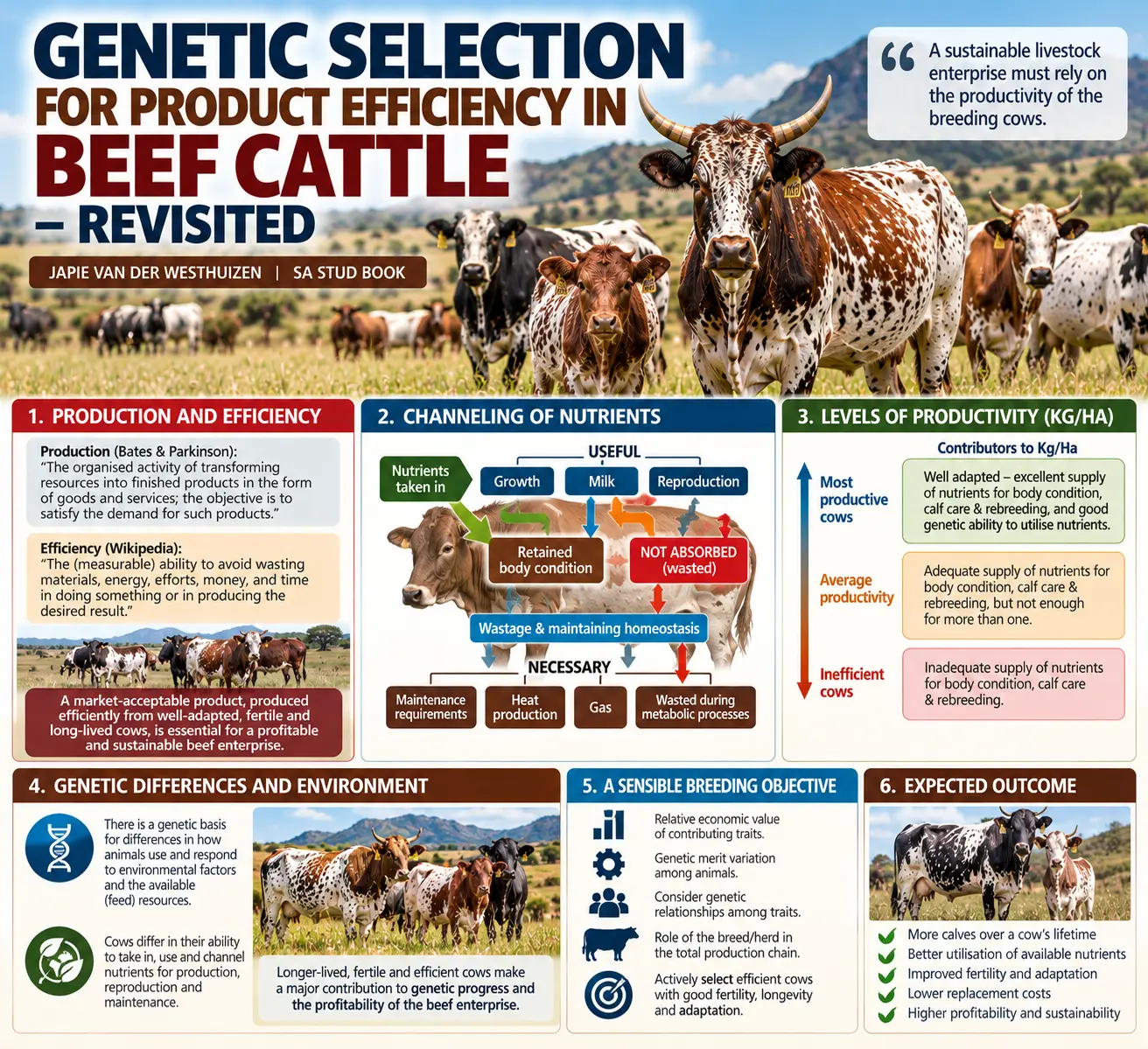
How can beef breeders select cattle for sustainable profitability rather than simply higher production? Japie van der Westhuizen revisits the principles of genetic selection for production efficiency, linking economic objectives with heritability, breeding values, genetic correlations and correlated responses to selection. He explains why breeding objectives must account for the relative economic importance of traits, environmental constraints and the role of the cow herd in the production chain. A practical Nguni bull example illustrates how SA Stud Book?s Cow Value, Growth Value and Production Value, together with fertility, maternal ability, longevity and maintenance requirements, can guide selection for more efficient and profitable beef production.
Download this publication
PDF · 872 KB
From the document
YOU SURE ABOUT THAT, SON ?
I KNOW JUST AS MUCH ABOUT MATH AS THE TEACHER !
GENETIC SELECTION FOR PRODUCT
Beef Cattle JAPIE VAN DER WESTHUIZEN
According to J. R. Hicks:
South African Stud Book & Animal
other peoples’ wants through exchange”. This definition
“Production is any activity directed to the satisfaction of
makes it clear that, in economics, we do not treat the mere making of things as production. What is made
must be designed to satisfy wants.
"The making or doing of things which are not
According to Bates and Parkinson: “Production is the organised activity of transforming
wanted or are made just for the fun of it does
resources into finished products in the form of goods
(therefore) not qualify as production. "
and services; the objective of production is to satisfy the demand for such transformed resources”. Setting the course.
www.economicsdiscussion.net 74
revisited Defining EFFICIENCY
or she manage to combine resources, both natural
Efficiency is the (measurable) ability to avoid wasting
the lowest average total cost). This also means, in
materials, energy, efforts, money, and time in doing something or in producing the desired result. In a more general sense, it is the ability to do things well, successfully, and without waste. (Wikipedia.org) For a primary beef cattle producer, the ultimate goal should be to optimise both allocative efficiency (where
and otherwise, in such a way to produce outputs at biological terms, being technical efficient, broadly defined as output obtained from any given input or the combination of inputs, such as total investment (fixed and variable), feed, labour, management allocation and others. (Adapted from economicsonline.co.uk)
A possible suitable combination of these
the market pay a price that reflects the marginal cost
terms will, therefore, in the case of beef cattle
of production) and productive efficiency (where he
production, results in striving for:
A market-acceptable product as reflected in the prices obtained as this product will satisfy the needs
Measurement & Recordings (with contemporary groups)
of such a market, especially in terms of a positive difference it will make to the profitability of the buyers of the product.
Maximising output to such an extent that the
Accuracy of predicted breeding value (genetic merit)
expected law of diminishing returns will not be
exceeded to such a degree that the beef cattle
Variation in genetic merit
enterprise cannot be sustained economically.
Minimising input without jeopardising the ability to
The opening of the PDF. Download it above for the full document.