How can genomic testing help beef cattle breeders make better-informed decisions beyond conventional performance recording? Jason Reding explores the practical applications of genomics, from understanding genetic relationships between breeds to identifying specific gene variants that influence polledness, double-muscling, meat tenderness, milk composition and inherited disorders. The article explains how these tests can support breeding decisions, help manage harmful recessive mutations and reveal opportunities for improving fertility, adaptation and disease resistance. It highlights why genomics is already a practical tool for South African cattle breeders, rather than merely a future prospect.
Download this publication
PDF · 350 KB
From the document
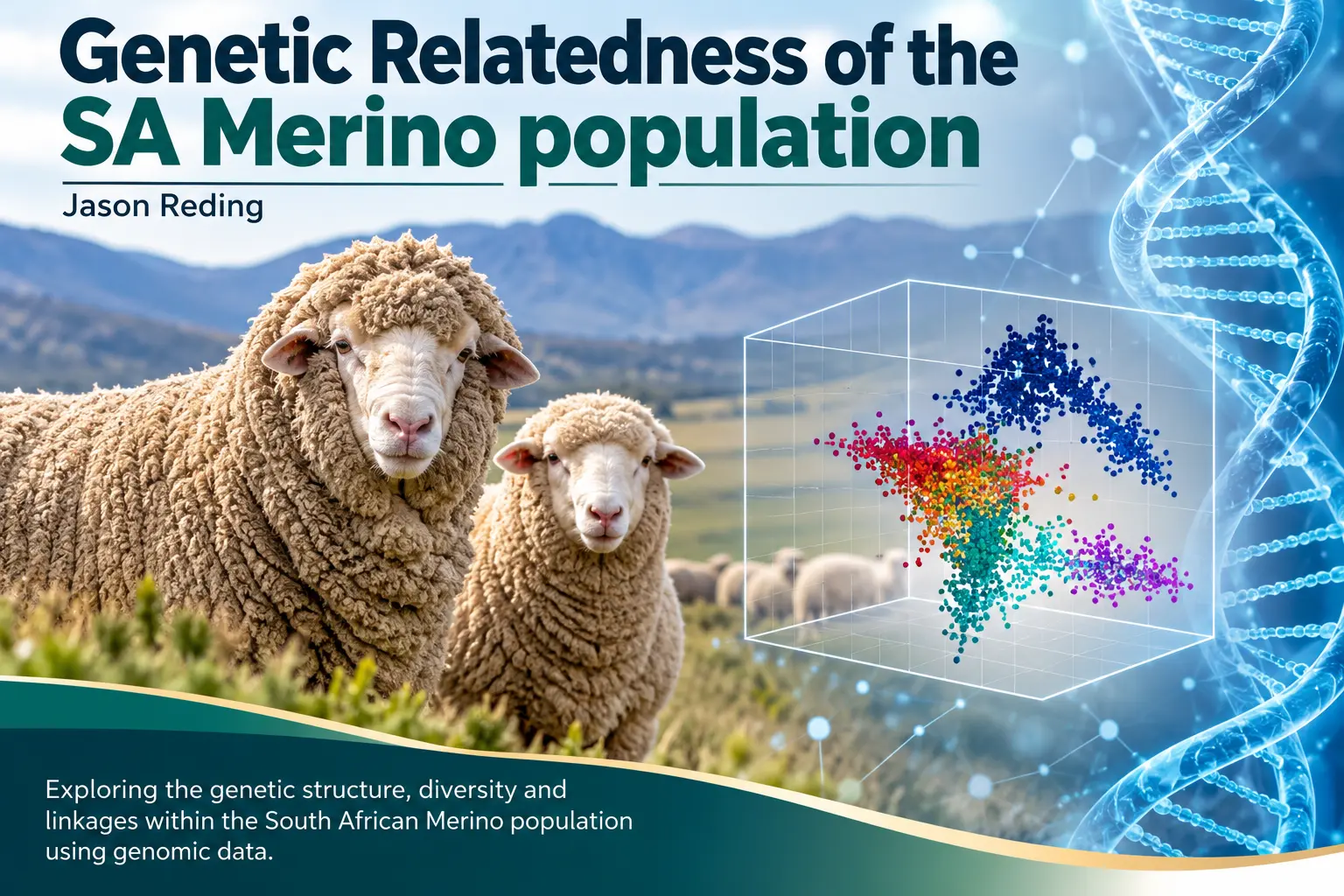
Genomics and Single Genes Available for Beef Cattle Jason Reding
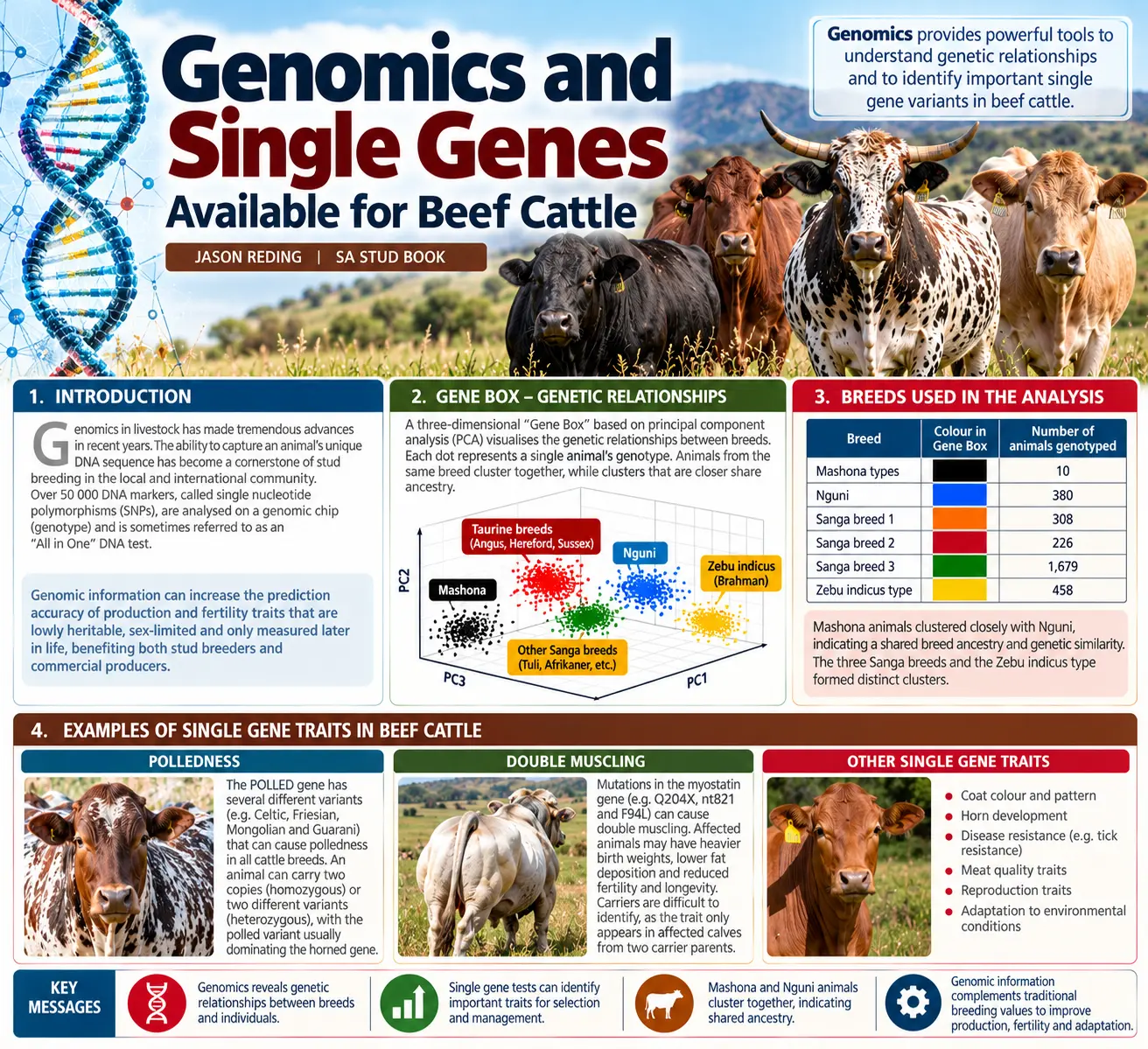
enomics in livestock has made tremendous advances in recent years. The ability to capture an animal’s unique DNA sequence has become a cornerstone of stud breeding in the local and international community. Over 50 000 DNA markers, called single nucleotide polymorphisms (SNPs), are analysed on a genomic chip (genotype) and is sometimes referred to as an “All in One” DNA test.
The use of genomic information in beef cattle has a significant impact on increasing the prediction accuracy of production and fertility traits that are lowly heritable, sexlimited and are only measured later in life (Berry et al., 2014; Van Marle-Köster & Visser, 2018). Although this aspect of genomics may be limited to breed societies with routine genetic evaluations, other vital cases should not be overlooked by commercial and informal livestock breeders.
G EN EBOX A three-dimensional “Genebox” can reveal the true depth of genetic
Indicine and Taurine breeds, as well as the corresponding composites. Each dot represents a single animal’s genotype, with animals from the same breed Setting the course.
clustering together. A larger cluster indicates a larger
(HH) for the Celtic variant. This indicated that a different
amount of genetic variation, while breeds that cluster
mutation on the POLLED gene may be responsible.
closer together share ancestry, such as the Sussex,
Further research has revealed three other variants within
Hereford, and Angus breeds, all of British Taurine origin.
this POLLED gene, such as the Friesian variant in Holsteins,
The Brahman and Taurine breeds cluster furthest from
the Mongolian variant in Kazakh breeds, and more
each other due to the opposing Indicine and Taurine
recently the Guarani variant in Nellore and Gyr breeds
genetics present in these breeds. The Nguni (in green),
(Nicholas et al., 2023). Currently, all four of these POLLED
a Sanga-type breed, clusters closely with the Tuli and
gene mutations can cause polledness in all cattle breeds.
Afrikaner Sanga-type breeds (Reding et al., 2021).
The myostatin protein regulates the normal growth
Genes have the ability to mutate or change. The
and development of muscle in an animal’s body. A few
common form of a gene is called the original or ‘wild
mutations can disrupt myostatin’s ability to function
type’. Some genes have many different variations, but an
normally, causing muscles to grow uncontrollably,
animal can only have two of these variants, one copy
The opening of the PDF. Download it above for the full document.