Accurate breeding values depend on distinguishing genetic differences from environmental effects. Dr Helena Theron explains why contemporary groups are fundamental to BLUP genetic evaluations and outlines four practical principles for breeders: group animals managed under comparable conditions, include progeny from at least two sires with a link sire where possible, build sufficiently large groups, and measure every animal?including poor performers before culling. The article shows how sound contemporary-group management improves fair comparisons between animals and strengthens the reliability of breeding-value estimates.
Download this publication
PDF · 974 KB
From the document
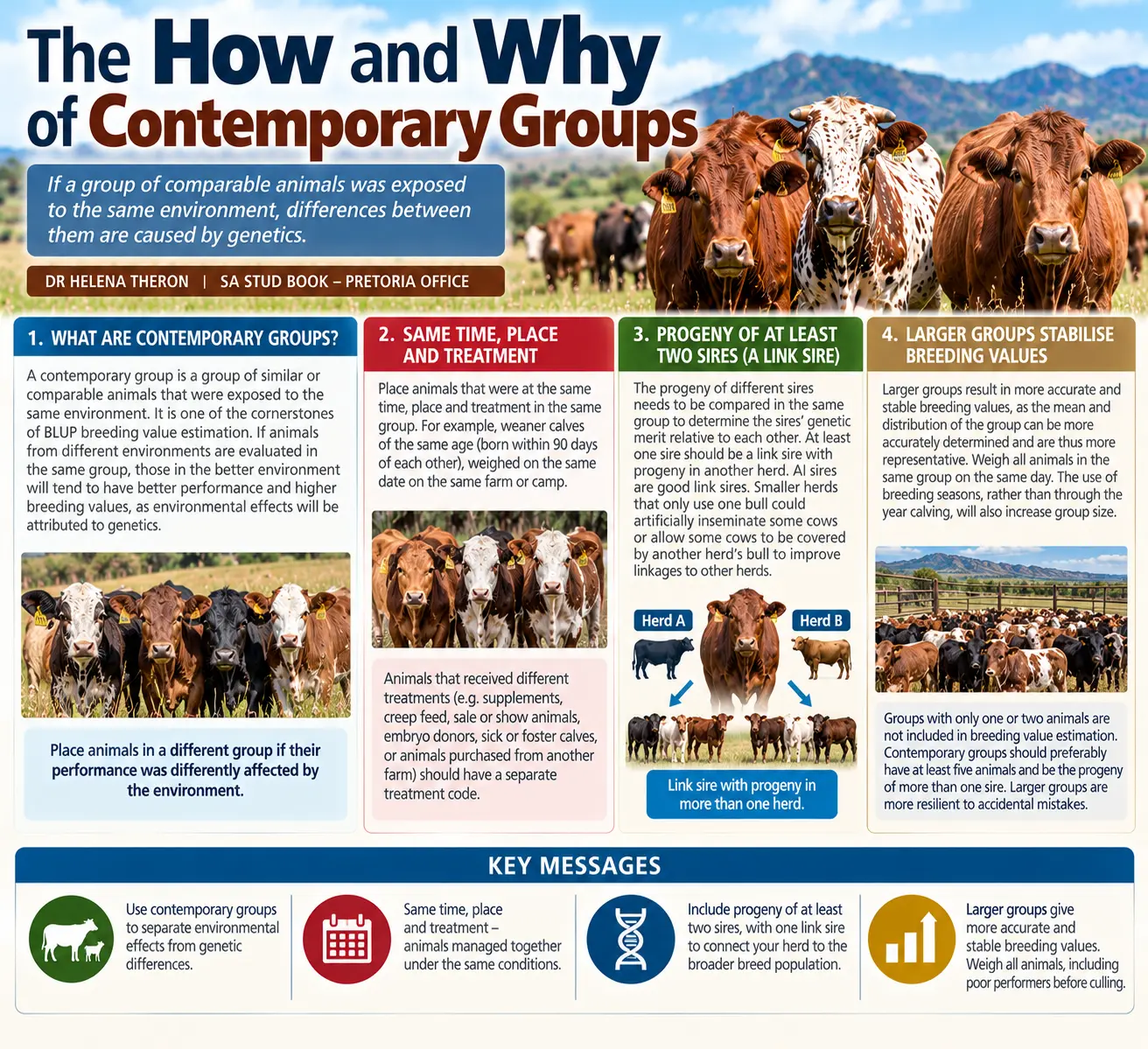
The and of Contemporary Groups If a group of comparable animals was
exposed to the same environment,
differences between them are caused by genetics.
he principle of contemporary
1. Place animals that were at the same time, place, and treatment in the same group
groups is used in breeding value estimation to indicate whether differences in performance can be attributed to environmental
or genetic effects. A contemporary group is a group of similar or comparable animals
that were exposed to the same environment.
The correct composition is one of the
measured at the same time in the
cornerstones of BLUP breeding value
same environment, for example, a group of weaner calves of the same age
(born between 90 days of each other), weighed on the same date on the same
Should animals exposed to different environments
farm. Therefore, it is a comparable group of
be evaluated in the same contemporary group, the
animals that were together on the same farm
animals in the better environment will tend to have
or camp in the same year and season.
better performance and, therefore, higher breeding values, as environmental effects will be attributed to
If there are some animals in the group that was
genetics. Therefore, it is important to identify animals
treated differently, they should be given a
that were exposed to the same environment or place
separate treatment code. Their performance
animals in a different group if their performance was
was influenced by other environmental
differently affected by the environment than their
influences than the rest of the group.
group mates. However, this is not as complicated as it
sounds, especially if the breeder keeps the following
treatments are when some animals
received supplements or creep Setting the course.
feed, sale or show animals, embryo donors,
in the same group on the same day as corrections for
sick or foster calves, or even cows and calves
age differences are made during the genetic evaluation.
purchased from another farm.
The use of breeding seasons, rather than through the year calving, will also increase contemporary group size
Corrections for sex, age of calf, and age of dam, are
simply because more calves are born closer together.
automatically made during breeding value estimation. This
One of the important cornerstones of breeding value
recording and therefore need not be considered by the
estimation is performance relative to the contemporary
The opening of the PDF. Download it above for the full document.