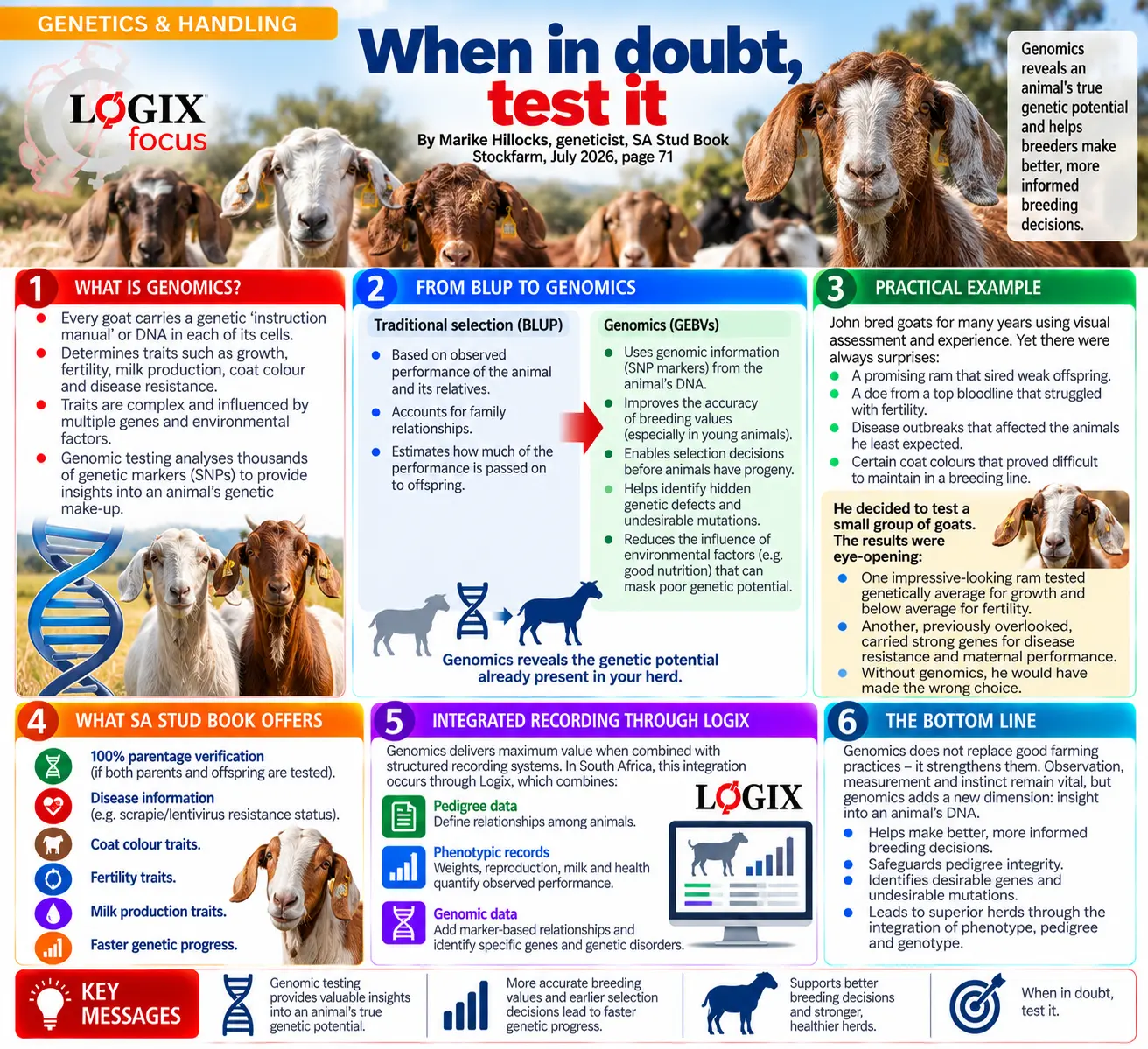
Can visual appraisal alone identify the best breeding goats? This article explains how genomic testing can reveal genetic merit that appearance and pedigree may not fully capture. Using a practical goat-breeding example, Marike Hillocks shows how genomic information can improve breeding value accuracy, verify parentage, identify desirable traits and detect harmful mutations. The article also explains how Logix integrates pedigree, performance and genomic data to produce genomically enhanced breeding values (GEBVs). Its central message is that genomics complements?not replaces?good management, accurate performance recording and experienced observation.
Download this publication
PDF · 265 KB · 1 download
From the document
When in doubt, test it By Marike Hillocks, geneticist, SA Stud Book
enomic testing is no longer a buzzword among goat breeders – it is reshaping the future of livestock breeding. At its core, genomics has the potential to unlock the secrets hidden in an animal’s DNA. By understanding an animal’s unique genetic blueprint, breeders can gain valuable insights into key traits, identify potential health risks associated with undesirable genes, and make more accurate predictions about the genetic potential an animal will pass on to future generations. With SA Stud Book’s new goat genomic services, breeders can refine estimates of genetic merit, safeguard pedigree integrity, and identify carriers of desirable single genes and undesirable mutations that influence herd performance.
What is genomics? Every goat carries a genetic ‘instruction manual’ or DNA in each of its cells, determining traits such as growth, fertility, milk production, coat colour, and disease resistance. These traits are complex, influenced by multiple genes and environmental factors. Consider a producer like John, who began breeding goats using only visual assessment and experience. He could identify a promising kid from across the kraal – a sturdy frame, a glossy coat, a doe that raised twins with ease. For many years, this approach worked reasonably well. Yet there was always a surprise of some kind. A promising young ram that sired weak offspring. A doe from a top bloodline that struggled with fertility. Disease outbreaks that sometimes affected the animals he least expected. Some goats handled drought conditions better than others, while certain coat colours proved difficult to maintain in
a breeding line. These inconsistencies reflect a fundamental biological reality: phenotype does not always accurately predict genotype. Genomics bridges this gap. John soon learned that it does not turn farms into laboratories or change animals – it reveals the genetic potential already present within the herd, giving producers the tools to make smarter breeding decisions.
Returning to John’s herd, he decided to test a small group of goats. The results were eye-opening. One of his most impressive-looking rams tested genetically average for growth and below average for fertility. Another ram, previously overlooked, carried strong genes for disease resistance and maternal performance. Without genomics, he would have made the wrong choice.
Traditionally, producers estimated genetic differences by observing the performance of animals and their relatives. Animal geneticists later formalised this process by developing best linear unbiased prediction (BLUP) breeding values …
The opening of the PDF. Download it above for the full document.