How can livestock breeders obtain more accurate, objective and frequent measurements without repeatedly handling animals? This article explores how 3D imaging, computer vision and artificial intelligence are transforming livestock phenotyping, from automated body measurements and condition scoring to growth monitoring. Using the PHENO3D project as a breeding-oriented example, it explains how remote measurements could strengthen genetic evaluations and genomic selection, while examining the technical, biological and economic challenges that must be overcome.
Download this publication
PDF · 750 KB · 1 download
From the document
JOERNAAL 2026 • JOURNAL 2026
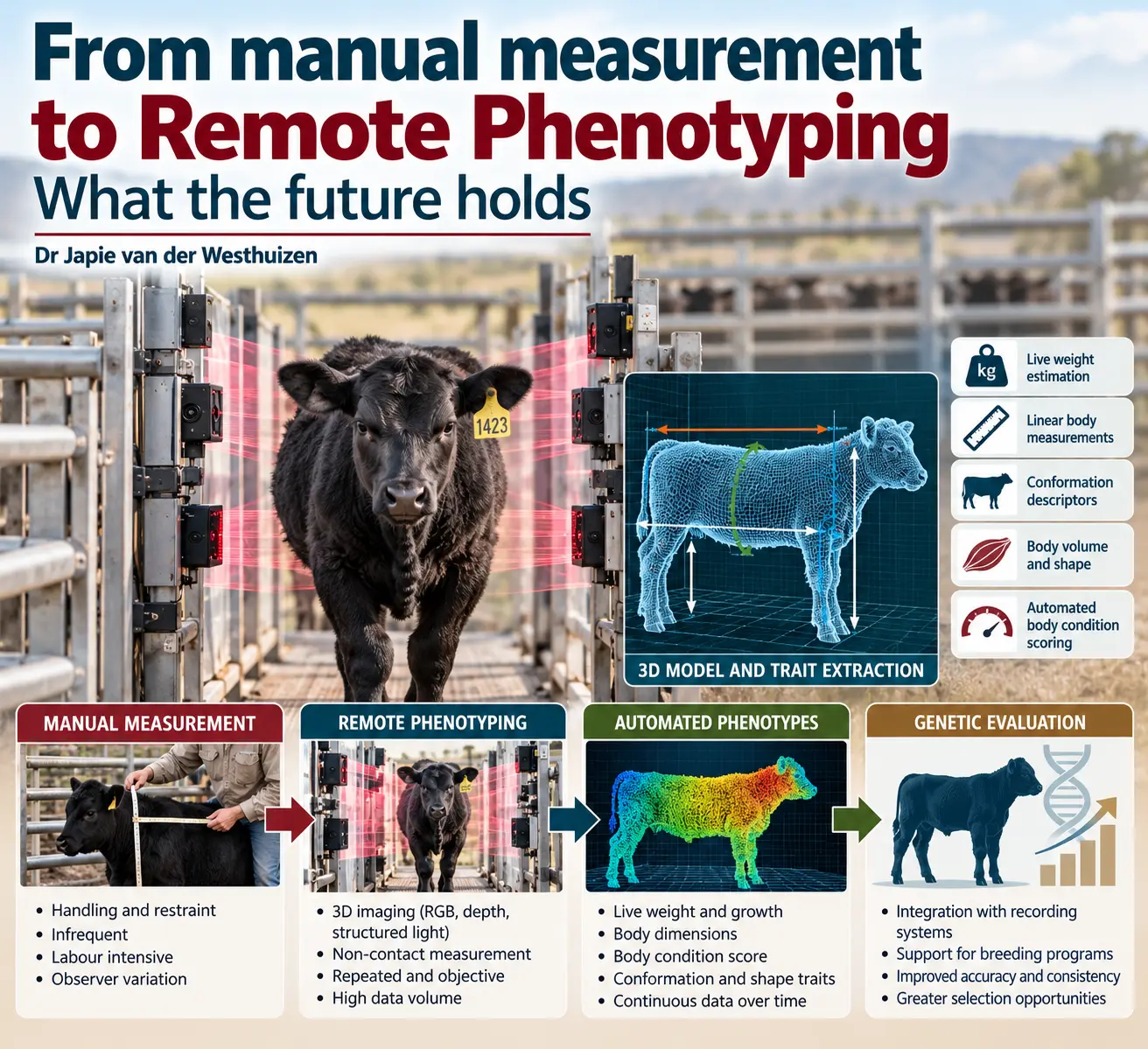
From manual measurement to Remote Phenotyping What the future holds Dr Japie van der Westhuizen
Traditional live-animal measurements, especially body dimensions, body condition scoring, and visual conformation assessment, require handling, restraint of animals and trained observers. Measurements are therefore normally infrequent, requires effort and time, is in effect very expensive (time and travel). Furthermore, observer effects are unavoidable, often bias, especially for subjective assessments. For breeding purposes, these factors not only limits data volume, but also consistency, repeatability and accuracy. Remote phenotyping technologies aim to overcome these constraints through non-contact measurement. Using combinations of RGB (visible light) cameras, depth sensors, and structured light or laser systems, animals can be reconstructed as 3D models from which body dimensions, volume, and shape descriptors are automatically extracted. 36
JOERNAAL 2026 • JOURNAL 2026
Although one of the main aims are automation, the ability to measure animals repeatedly and objectively without increasing labour or stress is also of paramount importance. Phenotype recordings then become continuous data rather than isolated (once-off) observations. Globally research and development takes place at public funded institutions as well as part of commercial ventures. The rapid developments of machine learning as building blocks for artificial intelligence is currently fast tracking these developments. PHENO3D: A Breeding-Oriented Example The PHENO3D project, being developed within the French beef cattle performance recording system, illustrates a decisive shift in focus. Rather than developing imaging technology in isolation, PHENO3D was designed explicitly to support genetic evaluation. The system uses a multi-sensor 3D imaging corridor through which calves pass during routine handling, typically at weaning. Depth cameras reconstruct the animal's full body surface, and algorithms automatically extract: • live weight estimates, • linear body measurements, • morphological descriptors related to conformation, • and volumetric traits derived from body shape. The primary objective is not to create entirely new traits, but to automate the collection of traits already used in breeding schemes while removing scorer subjectivity and reducing labour constraints. This distinction is important. Many imaging studies demonstrate technical feasibility under controlled conditions. PHENO3D addresses scalability, integration with existing recording structures, and compatibility with national genetic evaluation systems. A transition from engineering research to trustworthy operational phenotyping. Current Areas of Progress Automated body measurement and growth monitoring 3D imaging systems now estimate live weight and growth trajectories from body volume with accuracy approaching conventional weighing under controlled conditions. In dairy systems, overhead depth …
The opening of the PDF. Download it above for the full document.