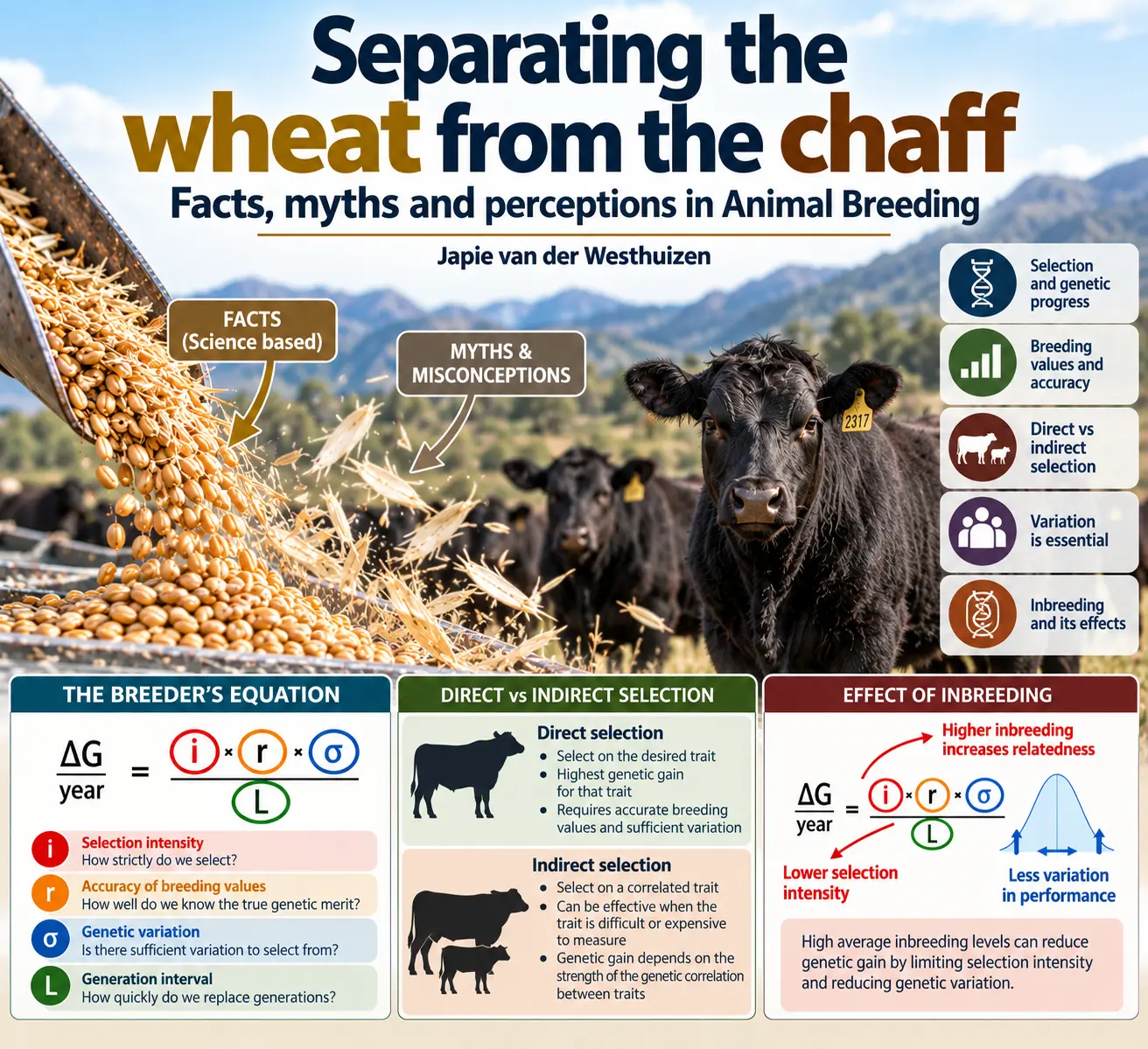
Are common beliefs about animal breeding supported by quantitative genetics? Japie van der Westhuizen examines five widely held statements about natural selection, genetic variation, heritability, indirect selection and inbreeding. Using genetic principles and practical breeding examples, he explains how breeding decisions affect genetic progress and why accurate breeding values, adequate variation and scientifically sound selection strategies matter. The article challenges simplistic assumptions and encourages stud breeders to distinguish established science from breeding myths
Download this publication
PDF · 347 KB · 4 downloads
From the document
JOERNAAL 2026 • JOURNAL 2026
Separating the wheat from the chaff Facts, myths and perceptions in Animal Breeding Japie van der Westhuizen One of the most successful programs on TV was “Myth Busters”. It dealt with things people see or believed in, truth of fiction. In many cases, perceptions of what is real and what is urban legends. Over the years, animal breeding and related aspects were always, and still are also subject to different belief systems and sometimes myths. Some still see it as a special gift to be able to select the right animals and others realise the science it is built on. The rapid development of predicting the true genetic merit of candidate selection material has opened new perspectives for several aspects related to breeding and genetics. Who has ever heard of Telegony? This is the belief that, as Wikipedia puts it: “offspring can inherit the characteristics of a previous mate of the female parent; thus, the child of a widowed or remarried woman might partake of traits of a previous husband”. The old belief of Maternal impression where “an emotional stimulus experienced by a pregnant woman (or animal) could influence the development of the foetus” has, however come under the spotlight with the theoretical and subsequent experimental work related to epigenetics, and it's influence on the expression of genes (even over generations). Although some myths might sound ridiculous to most breeders of livestock, some phrases or concepts are sometimes still misunderstood or
even misused in the breeding industry. Some are touched on. Statement 1: “Natural selection is where you select animals in a natural environment.” Although many definitions of Darwin's original observations and description exist, one appropriate definition can be as follows: “The process by which organisms that are better suited to their environment than others produce more offspring. As a result of natural selection, the proportion of organisms in a species with characteristics that are adaptive to a given environment increases with each generation. Therefore, natural selection modifies the originally random variation of genetic traits in a species so that alleles that are beneficial for survival predominate, while alleles that are not beneficial decrease.” (The American Heritage® Science Dictionar y. Houghton Miff lin C o m p a n y. < D i c t i o n a r y. c o m http://www.dictionary.com/browse/ natural-selection>.) In short, this means, animals possessing the alleles (forms) …
The opening of the PDF. Download it above for the full document.