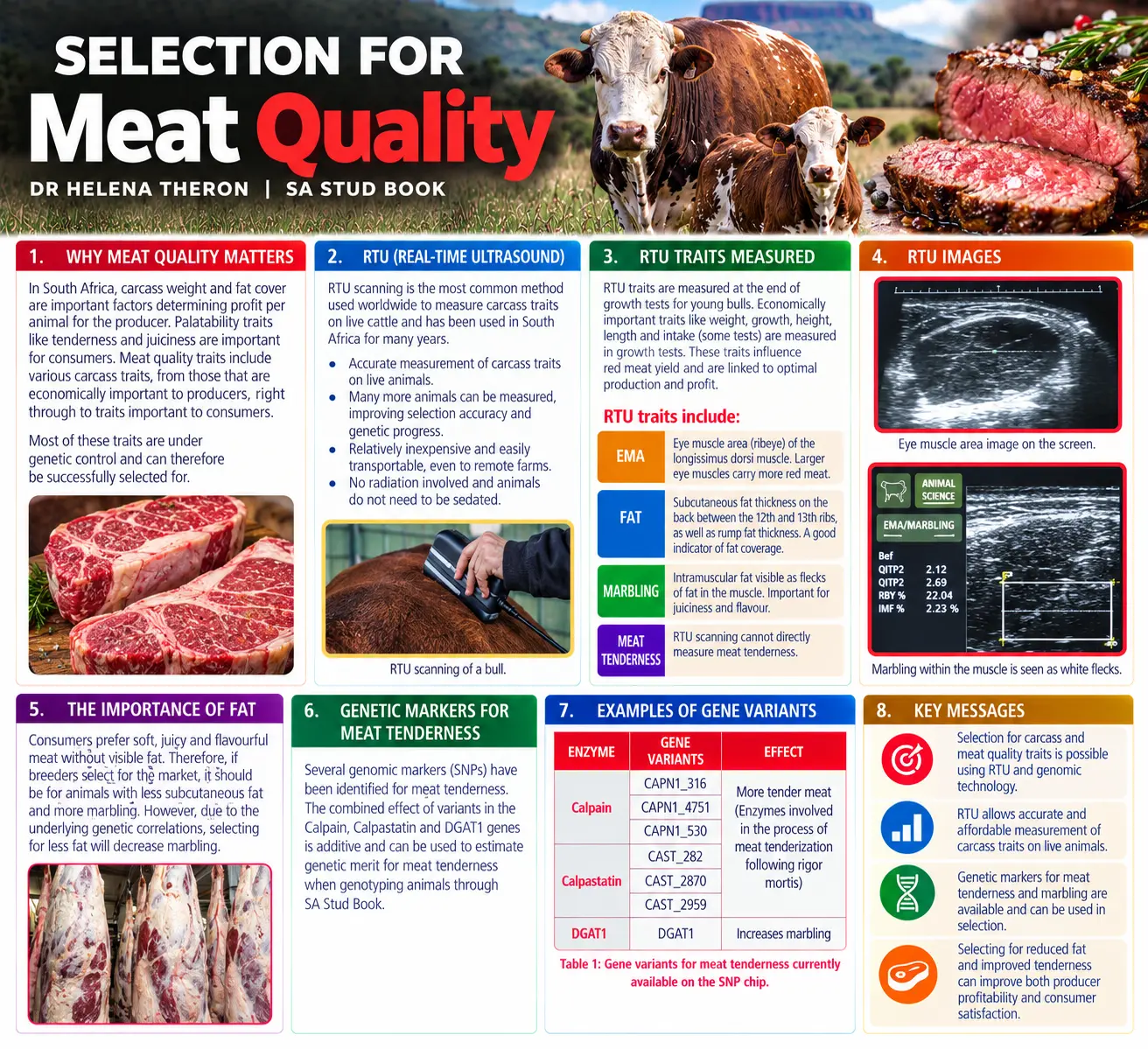
How can beef breeders improve carcass value and eating quality through genetic selection? Dr Helena Theron explains how real-time ultrasound (RTU) scanning enables the measurement of eye muscle area, fat thickness and marbling in live cattle, while genomic markers provide additional information about meat tenderness. The article examines the trade-offs between subcutaneous fat, marbling, fertility and growth, and introduces the roles of the calpain, calpastatin and DGAT1 genes. It also explains how genomic estimated breeding values (GEBVs) can improve selection accuracy, supporting more balanced breeding decisions for both producer profitability and consumer satisfaction
Download this publication
PDF · 673 KB
From the document
Meat Quality DR HELENA THERON | SA STUD BOOK
INTRODUCTION n South Africa, carcass weight and fat cover are important factors determining profit per animal for the producer. Palatability traits like tenderness and juiciness, however, are important for consumers. Meat Quality traits can therefore be broadly defined to include various
carcass traits, from those that are economically important to producers, right through to traits important to consumers. Most of these traits are under genetic control and can therefore be successfully selected for.
Carcass data was historically collected with progeny
however a very expensive and slow way of evaluating
testing. The calves of potential stud bulls were placed
bulls, resulting in only a few bulls’ genetic abilities
in a feedlot and carcass and meat quality traits were
for carcass traits being measured. Fortunately, using
measured on the carcasses of the offspring. This is
modern-day technology, this is not the case anymore.
RTU (Real-Time Ultrasound)
traits like weight, growth, height, length, as well as intake
One of the advantages of the ability to accurately measure
(some tests) of young bulls, are measured in growth tests.
carcass traits on live animals is that many more animals
These traits influence red meat yield and are therefore
can be measured. These improve selection accuracy
linked to optimal production and profit.
and thus genetic progress. RTU (Real-Time Ultrasound) scanning is currently the most common method used
worldwide to measure carcass traits on live cattle and has
EMA: the eye muscle area of the longissimus dorsi
been used in South Africa for many years. RTU scanning
(ribeye) muscle. Animals with larger eye muscles have
is relatively inexpensive. The device is easily transportable,
scientifically been found to carry more red meat.
even to remote farms. There is also no radiation involved
FAT: subcutaneous fat thickness on the back of the
and animals do not need to be sedated
animal between the 12th and 13th ribs, as well as Rump fat thickness. Backfat thickness is a good indicator of fat coverage on the carcass, while rump fat thickness is beneficial when scanning very lean animals and can be used to improve the overall fat coverage estimate. MARBLING: The intramuscular fat, which is sometimes visible as flecks of fat inside the muscle, is an important characteristic of cooked meat, affecting both juiciness and flavour and is important to consumers. MEAT TENDERNESS: RTU scanning cannot directly measure meat tenderness.
The opening of the PDF. Download it above for the full document.