How much marbling is desirable in beef, and are the claimed benefits supported by scientific evidence? Prof. Phillip Strydom examines the effects of intramuscular fat on tenderness, juiciness, flavour and consumer acceptance, while distinguishing evidence-based findings from common misconceptions about nutritional value. He discusses the influence of marbling level and distribution, genetics, nutrition and animal management, explaining why more marbling is not always better. The article provides a balanced perspective on marbling as a beef quality trait, including its implications for breeding, production and consumer health.
Download this publication
PDF · 381 KB · 1 download
From the document
PROF. PHILLIP STRYDOM DEPARTMENT OF ANIMAL SCIENCES FACULTY OF AGRISCIENCES, STELLENBOSCH UNIVERSITY pestrydom@sun.ac.za
he role of marbling in the eating experience of beef and other red meats is well established. However, I get the impression that claims about the benefits
of marbling are quoted often without sufficient scientific support. These may confuse the consumer and, in the end, work against the efforts to promote marbling as a quality trait in beef and other red meat species. This is a short but certainly not comprehensive discussion about marbling and an attempt to provide some facts around certain issues about marbling.
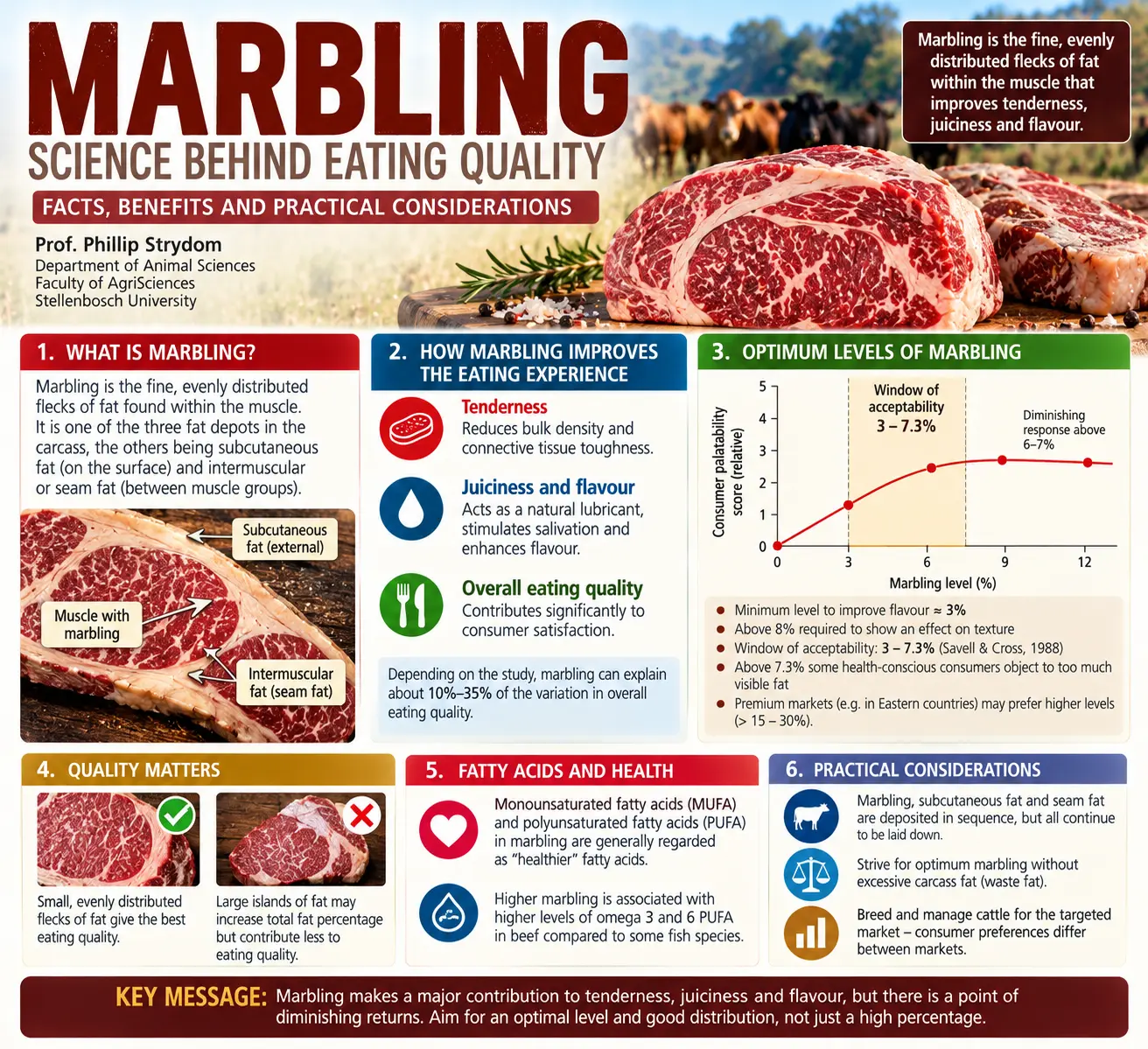
Marbling is the fine, evenly distributed flecks of fat
It is also important to note that these fat depots are
found through the muscle.
laid down in a different sequence during the animal’s
of phospholipids is found within muscle tissue (cell
life. Intermuscular or seam fat is normally deposited at
membranes), marbling fat occurs in the spaces between
a higher rate at first, followed by subcutaneous fat and
muscle bundles. It is one of the three fat depots of the
carcass, the other two being subcutaneous fat – on the surface of the carcass and intermuscular fat found
However, deposition of fat depots in this order does not
between major muscle groups.
mean that one depot will stop being deposited when the Setting the course.
other accelerates its deposition but will rather continue
and crossbred Wagyu, show marbling fat levels in the
to be laid down. These are, of course, important in the
upper 20s and even 30s (%).
context of striving for optimum levels of marbling, also called the “taste” fat, because in most cases, it means
Certain studies indicate that a minimum level of
that there is also an abundance of “waste” fat in the
marbling required to improve the flavour is 3%, and
carcass when this point is reached.
above 8% is required to show an effect on texture. Savell and Cross (1988), researchers from the USA, established
Marbling contributes to the eating experience of red
a window of acceptability and report a dramatic increase
meat through positive effects on the consumer’s
in palatability scores by consumers when marbling
perception of tenderness, juiciness, and flavour. Some
increases from 0 to 3%. Between 3 and 6%, the increase
studies claim that marbling explains 20% to 35% of the
The opening of the PDF. Download it above for the full document.