Practical guide for body condition scoring in cattle
Download this publication
PDF · 399 KB · 90 downloads
From the document
By Dr Helena Theron, Siebert Vermeulen & Dr Japie vd Westhuizen
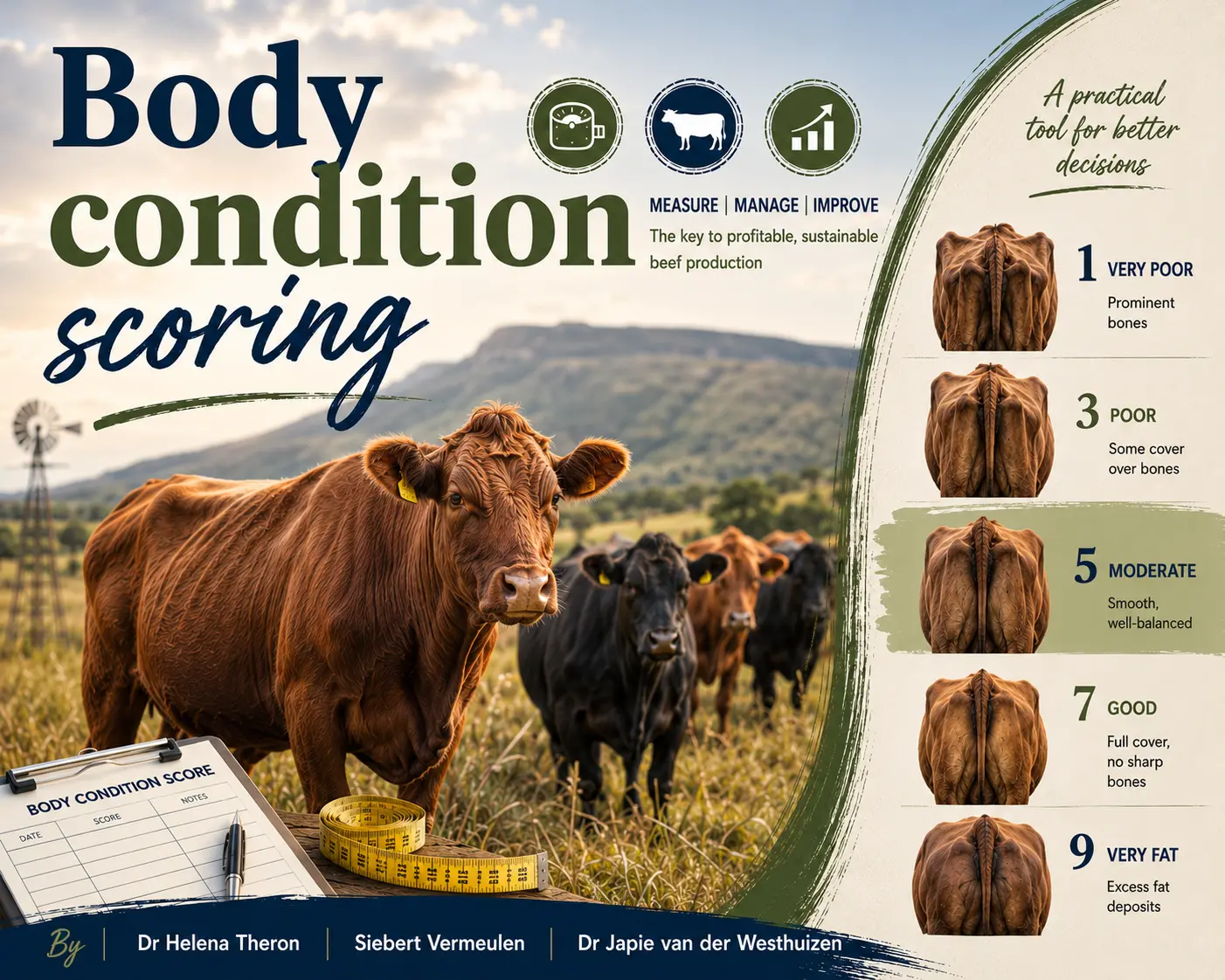
Body Condition Scoring of a cow herd is a quick and easy way to facilitate management and address potential problems timeously. It can be used to identify adapted animals, improve pregnancy rates and even reduce calving problems. Recording body condition scores is a tool to improve production and therefore profit.
How to do body condition scoring 2 3
1. Back 2. Tail head 3. Pins 4. Hooks 5. Ribs 6. Brisket
Figure 1: Areas useful for visually determining BCS in beef cows. (Oklahoma State University)
Figure 2: Specific anatomical areas used in determining BCS in beef cows. (Adapted from Herd and Sprott, 1986.) 26
In times of abundance, animals store excess energy as fat. This is nature’s protective mechanism. When feed becomes scarce, animals will first use fat reserves and then muscle tissue as an energy source. The first source of fat energy that is utilized is normally the fat around the organs and then subcutaneous fat. Differences in subcutaneous fat are therefore a good indication of the total fat energy available to animals before the breakdown of muscle tissue starts, which can have very serious disadvantages, and even cause permanent damage. Body condition scoring is determined by palpating or visually assessing the quantity of fat and muscle over bony prominences in animals (see Table 1). The evaluation of fat reserves is conducted independently of factors such as pregnancy, rumen fill, age, coat length, season, or stage in the production cycle.
Body Condition Score (BCS) is an indication of the total amount of fat on the animal. The animals' fatness is visually scored on a scale of 1 to 9, where thin (lean) cows appear thinner, sharper and more bony, while fat cows appear smooth and blocky without visible bones. The Body Condition Score is therefore an indication to what degree the spine, pelvic bones, tailhead and brisket are covered with fat (Figures 1 & 2). Some breeders also use the 1 to 5 scale of scoring, with half scores in between, which can easily be converted to the 1 to 9 scale. It is a subjective measure, so different people may give the same animal a different score. It is therefore advisable to hone a scorer’s skills by practicing regularly and be subjected to the skills of other trustworthy scorers.
The opening of the PDF. Download it above for the full document.