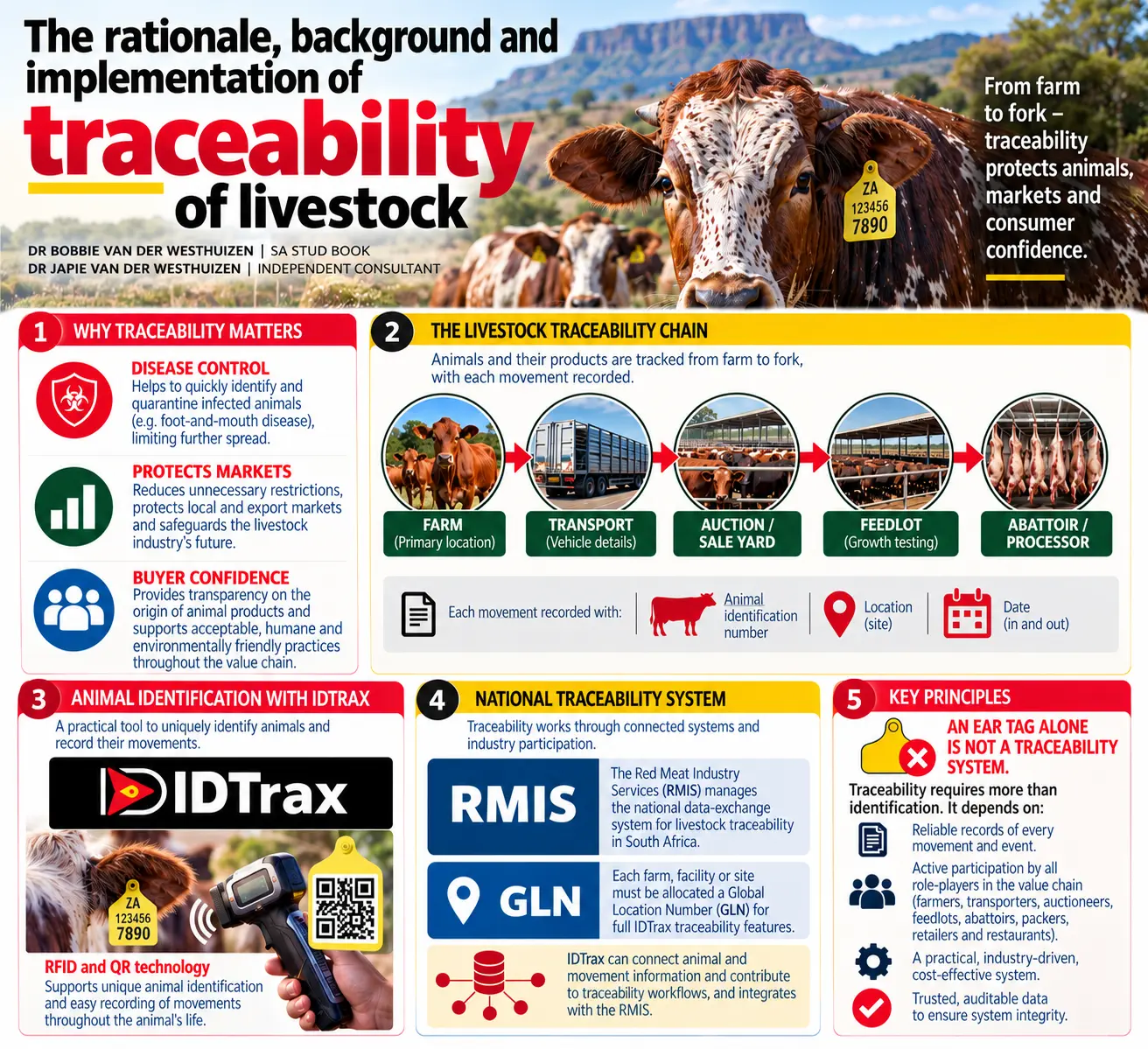
Why does South Africa need a reliable national livestock traceability system? This article explains how unique animal identification and recording movements throughout the production chain can help contain foot-and-mouth disease (FMD), protect market access and reduce unnecessary restrictions on unaffected areas. It outlines the responsibilities of farmers, transporters, auctioneers, feedlots, abattoirs and recording systems, and explains why a centralised, auditable system requires industry-wide participation. The practical relevance is illustrated by IDTrax, which adds digital tools for animal identification, movement recording and tracking to the wider traceability process.
Download this publication
PDF · 1 MB
From the document
The rationale, background and implementation of
traceability of livestock
DR BOBBIE VAN DER WESTHUIZEN SA STUD BOOK AND DR JAPIE VAN DER WESTHUIZEN INDEPENDENT CONSULTANT
coli contamination, and residues such as antibiotics, from substances administered to production animals.
he ability to track animals and animal products from farm to fork has come to a critical turning point for South Africa’s animal production,
Although the first needs centred on human health, the demands for traceability rapidly increased as consumers sought much more transparency regarding the origins of their food. This need goes beyond health, including factors such as acceptable, humane and environmentally friendly animal husbandry practices, transportation conditions,
especially, as illustrated, during the
clear and accessible documentation covering all
current foot-and-mouth disease (FMD)
stages within the production chain. This has also led to
outbreaks. Without a sound traceability system, multiple FMD outbreaks
traceability evolving into, not only a health safeguard but also a marketing tool that provides consumers with confidence in both product safety and ethical standards.
disrupted both local and export markets. An effective national industrydriven traceability system will assist in containing the spread of any health-related outbreak, protect trade relationships, and safeguard the livestock industry’s future.
Consequently, it is built on the necessity for reliable, tamperproof
systems for animals, as well as comprehensive records documenting each phase of the production process. Moreover, effective traceability requires linking animals to their derived products, such as ensuring that
Traceability, within compartments, allows authorities
carcasses and meat cuts, can be traced back to the
to identify and quarantine infected animals rapidly, ,
originating live animal and place of origin.
preventing further spread to other compartments or regions. Precision tracking of animals ensures a focused disease management program, instead of blanket restrictions, reducing economic losses for producers,
Brief overview of a traceability system
auctioneers, feed-lots, abattoirs, packers, retail and A traceability system is composed of interconnected
compartments such as primary or farm locations, A sound tractability system must be effective, practical
transportation, auction or sale yards, feedlots, abattoirs,
implementable and cost-effective. Every role-player in
packers, retail outlets and even restaurants, linked
the value chain, from the animal’s birth to the retailers
through an audit-able computer system, and maintained
and restaurants, must buy into such a system and be
by a series of audits to ensure quality control. Each item
actively involved to ensure trusted, reliable data.
The opening of the PDF. Download it above for the full document.